

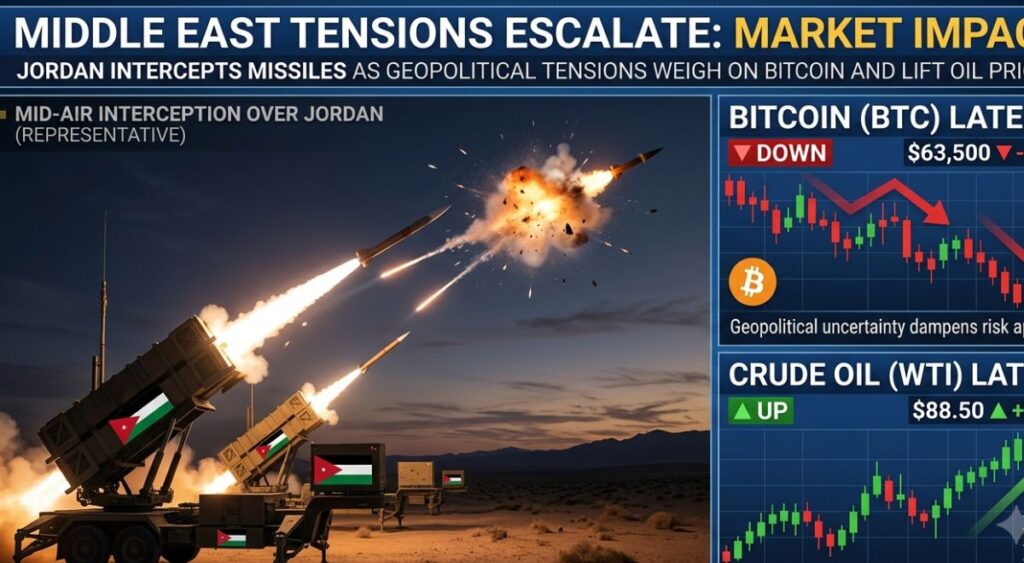
Jordan’s military intercepted three Iranian ballistic missiles that entered its airspace early on July 15, preventing casualties and significant damage as regional tensions continued to rise. The incident briefly unsettled financial markets, with Bitcoin edging lower while oil prices recorded a sharp gain.
Jordan intercepts missiles entering its airspace
The interceptions took place at dawn after the missiles crossed into Jordanian airspace. Military engineering teams were deployed to recover debris that landed in several locations across the country.
The missiles were reportedly headed toward areas near Jordanian military installations that host US forces, highlighting Jordan’s strategic role amid heightened tensions involving Iran and the United States. Local reports have suggested Jordanian forces have intercepted multiple missiles in recent weeks, although estimates vary.
Jordanian authorities reiterated that the country remains committed to safeguarding its airspace and responding decisively to any security threats.
Bitcoin dips while oil prices rally
Cryptocurrency markets reacted cautiously to the developments. Bitcoin declined to around $62,600–$63,000 following news of the interceptions, reflecting a relatively modest move compared with previous regional flare-ups.
The reaction contrasted with the Iran-Israel escalation in April 2024, when Bitcoin lost roughly 8% over a single weekend. This time, the decline remained limited despite growing geopolitical uncertainty.
Meanwhile, oil prices climbed nearly 4% as investors priced in the risk of potential supply disruptions linked to escalating tensions in the Middle East.
Implications for crypto markets
The latest market response reinforces Bitcoin’s tendency to trade as a risk-sensitive asset during periods of geopolitical uncertainty rather than consistently acting as a traditional safe haven.
Sustained increases in oil prices could fuel inflationary pressures, potentially influencing central bank monetary policy and delaying expectations for interest rate cuts. Such a scenario may create additional pressure on risk assets, including cryptocurrencies.
Market participants will closely monitor whether Iran carries out further military action and whether elevated oil prices persist, as both factors could shape broader market sentiment and influence Bitcoin’s near-term direction.