

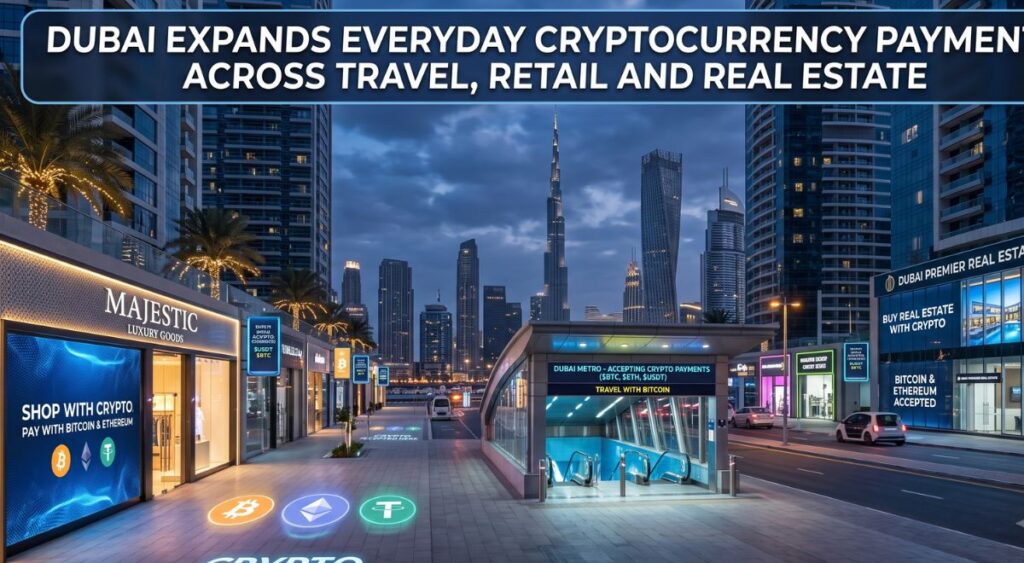
DUBAI — Dubai is steadily integrating cryptocurrencies into everyday commerce, with airlines, government entities, retailers and property developers embracing regulated digital asset payments as the emirate advances its ambitious cashless economy agenda.
The wider adoption of cryptocurrency payments aligns with Dubai’s Cashless Strategy, a key pillar of the D33 Economic Agenda, which aims to digitise 90% of public and private sector transactions by 2027. While digital assets were once viewed as a niche payment option, they are increasingly becoming part of mainstream economic activity across the emirate.
The aviation sector is among the latest industries to adopt the technology. Emirates has introduced Crypto.com Pay for customers in the UAE booking flights in UAE dirhams through the airline’s website and mobile application. The rollout follows a memorandum of understanding signed in 2025 between Emirates and Crypto.com to explore cryptocurrency payment solutions for digital checkouts.
Retail is also witnessing significant progress. Dubai Duty Free now enables UAE residents to pay using Crypto.com Pay at airport outlets and through its online platform, making it the first airport retailer in the Middle East to introduce a regulated cryptocurrency payment option. In both cases, customers pay using their digital assets while merchants receive settlements in UAE dirhams through an authorised payment infrastructure.
Government Services Move Toward Crypto Payments
Dubai is also preparing to extend cryptocurrency adoption to government services. Under an agreement between the Dubai Department of Finance and Crypto.com, residents will be able to pay government fees using digital assets.
The payment process will remain fully regulated, with cryptocurrency transactions converted into UAE dirhams before funds are transferred to government accounts, ensuring compliance with existing financial regulations.
Real Estate Sector Embraces Digital Assets
Dubai’s real estate market is also expanding the use of cryptocurrencies for property transactions. Purchasing property with digital assets is legally permitted, provided the cryptocurrency is converted into UAE dirhams through an authorised intermediary before ownership registration is completed.
This means property ownership is not recorded directly in Bitcoin or other cryptocurrencies. Instead, the conversion occurs before or during the official transfer process, with final registration completed in local currency.
Several leading developers, including Damac, Emaar, Nakheel and Ellington Properties, have already introduced cryptocurrency payment options, subject to seller approval and regulatory requirements.
Meanwhile, the Dubai Land Department continues to develop blockchain-based property initiatives designed to improve market accessibility. Recent programmes have focused on expanding opportunities for fractional property ownership through lower investment thresholds.
Industry experts note that tokenisation and cryptocurrencies serve different purposes. Tokenisation creates digital representations of real-world assets such as property, while cryptocurrencies function as blockchain-native digital currencies. However, the combination of both technologies could significantly reshape property investment and ownership models in the coming years.
Strengthening a Regulated Digital Asset Ecosystem
The UAE continues to position itself as a global centre for regulated digital assets, attracting international virtual asset companies, institutional investors and financial technology firms.
In Dubai, oversight of the sector is led by the Virtual Assets Regulatory Authority (VARA), which regulates virtual assets and service providers across the emirate, excluding businesses operating within the Dubai International Financial Centre.
Alongside Dubai’s rapid progress, Abu Dhabi is also expanding its digital asset ecosystem, reinforcing the UAE’s broader strategy to become one of the world’s leading regulated hubs for blockchain innovation and cryptocurrency adoption.