

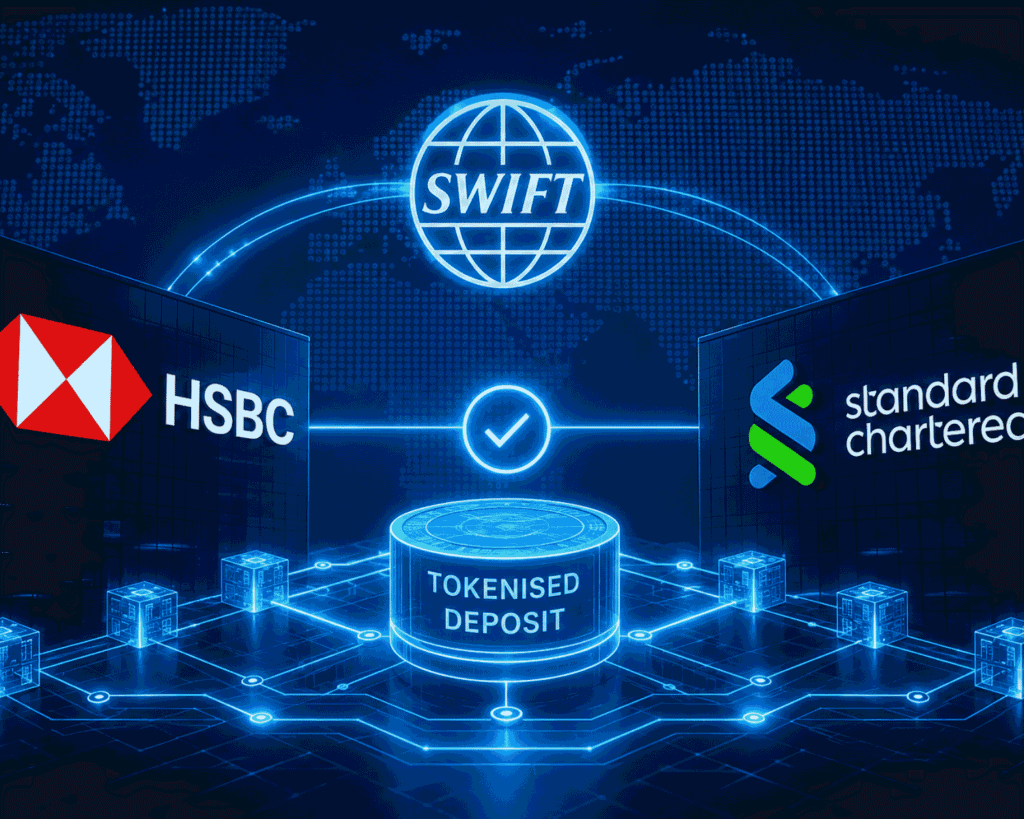
HSBC and Standard Chartered have completed the first live cross-border bank transaction using tokenised deposits through Swift’s blockchain-based ledger, marking an important step toward the practical use of blockchain technology in global banking.
The transaction moves the financial industry beyond controlled experiments and pilot projects, demonstrating that regulated digital money can operate across different banking infrastructures. The development could eventually support faster, more flexible liquidity management and round-the-clock cross-border settlement.
First Live Interbank Transaction
The transaction involved the exchange of payment messages between HSBC and Standard Chartered, with the resulting obligations recorded as tokenised deposits within each bank’s internal infrastructure.
HSBC used its Tokenised Deposit Service (TDS), while Standard Chartered relied on its own tokenised-deposit infrastructure. Swift’s blockchain-based ledger acted as the coordination layer, enabling the two institutions to match and net their obligations before final settlement through existing banking systems.
The successful transaction follows Swift’s July 2026 announcement that its blockchain-based ledger was ready for initial use. Seventeen banks across six continents are preparing to participate in live pilots, making the HSBC-Standard Chartered transaction the first completed interbank transaction on the platform.
Why Tokenised Deposits Matter
Traditional cross-border payments can be slowed by time-zone differences, banking cut-off periods, multiple intermediaries and manual processes. Tokenised deposits are designed to address some of these limitations by allowing regulated banks to represent deposits digitally and transfer related obligations through blockchain-based infrastructure.
The technology could enable financial institutions to manage and settle transactions around the clock rather than being constrained by traditional banking schedules.
For corporate customers, wider adoption could improve liquidity management, provide greater visibility over cash positions and reduce some of the operational complexity involved in international payments.
The Banks Behind the Transaction
Swift operates as a major global provider of secure financial messaging services, connecting more than 11,000 banking and securities organisations worldwide. Its move into blockchain-based infrastructure represents an expansion of its role beyond traditional financial messaging toward coordinating digital-asset transactions.
HSBC has been developing its Tokenised Deposit Service as part of its broader strategy to integrate digital money into corporate banking. The bank has emphasized the importance of interoperability while maintaining the regulatory controls associated with conventional banking infrastructure.
Standard Chartered has also invested heavily in digital assets and emerging payment technologies, particularly for corporate and institutional customers. Its work in tokenised deposits forms part of a broader strategy focused on modernising payments and liquidity management.
A Boost for Regulated Digital Money
The transaction is significant because it demonstrates how blockchain technology can be integrated with the existing regulated banking system rather than operating entirely outside it.
Tokenised deposits represent claims on regulated commercial banks, giving the model a different structure from privately issued stablecoins. By connecting the tokenised-deposit systems of HSBC and Standard Chartered through Swift, the project shows that blockchain-based settlement can potentially coexist with established banking controls and infrastructure.
The development could also increase competitive pressure on stablecoin providers, which have been among the leading players in the market for 24/7 digital payments and transfers.
What Comes Next?
The next major test will be the expansion of Swift’s 17-bank pilot network. Successfully connecting more institutions could create the network effects needed for tokenised deposits to become a more widely used solution for wholesale cross-border payments.
If adoption continues, tokenised deposits could help modernise the correspondent banking model by combining blockchain-based transaction processing with the regulatory framework and trust of established financial institutions.
The industry is now moving beyond the question of whether tokenised deposits can work in practice. The bigger question is how quickly the technology can scale across banks, markets and currencies.