

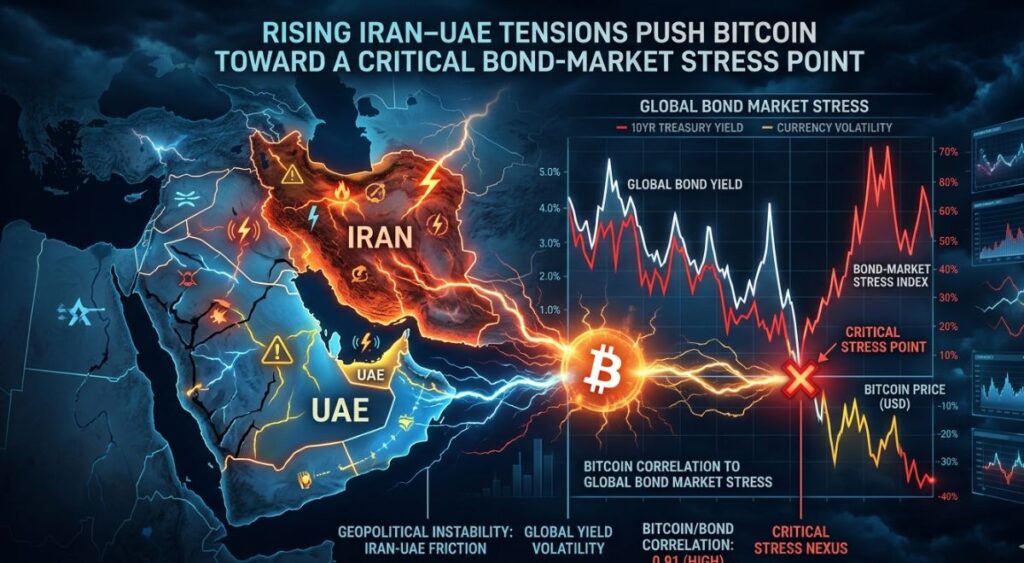
Escalating conflict between Iran and the United Arab Emirates is rippling across global markets, driving oil prices higher and putting fresh pressure on bonds—while forcing Bitcoin into a pivotal test of its role in times of economic stress.
Recent attacks targeting shipping lanes in the Strait of Hormuz and a drone strike on Fujairah’s oil infrastructure sent energy markets surging. Brent crude climbed above $114 per barrel, while U.S. benchmark WTI rose past $106. At the same time, U.S. Treasury yields spiked, with the 10-year nearing 4.44% and the 30-year bond moving above 5%—levels that tighten financial conditions across the economy.
Bitcoin, meanwhile, briefly surged to an intraday high of $80,717 on May 4, underscoring a growing debate among investors: is the cryptocurrency a hedge against macroeconomic instability, or does it remain vulnerable to rising interest rates and tighter liquidity?
Oil shock spreads beyond energy markets
The Strait of Hormuz, a critical chokepoint through which roughly one-fifth of global oil and liquefied natural gas flows, has become the focal point of market anxiety. Disruptions there have quickly translated into broader inflation fears, pushing borrowing costs higher worldwide.
As yields rise, the effects cascade through the economy—mortgage rates increase, corporate borrowing becomes more expensive, and equity valuations come under pressure. Recent data from Freddie Mac shows U.S. 30-year fixed mortgage rates edging above 6.3%, reflecting the broader tightening trend.
Federal Reserve faces a narrowing path
The inflationary impact of elevated oil prices is complicating the outlook for the Federal Reserve. With crude holding above $100, expectations for rate cuts are being pushed further out.
Barclays now forecasts the first potential rate cut as late as March 2027, while data from CME FedWatch Tool suggests markets see a high likelihood of no policy change through the end of 2026.
At the same time, increased government borrowing is adding further upward pressure on yields. The U.S. Treasury expects to raise hundreds of billions of dollars in the coming quarters, increasing bond supply in a market already sensitive to inflation risks.
Bitcoin caught between two narratives
The current environment presents a paradox for Bitcoin. On one hand, rising geopolitical tension, persistent inflation, and expanding government debt reinforce its appeal as a “hard money” alternative to traditional currencies.
Institutional interest remains strong. BlackRock’s spot Bitcoin ETF, IBIT, held over $63 billion in assets by early May, while U.S.-listed Bitcoin ETFs recorded hundreds of millions in daily inflows—evidence of sustained demand from large investors.
On the other hand, higher yields and a stronger U.S. dollar are dampening appetite for risk assets. Even traditional safe havens like Gold declined amid the latest surge in rates, highlighting how attractive cash returns can outweigh hedging demand in the short term.
What comes next
Bitcoin’s trajectory now hinges on the direction of both geopolitics and the bond market.
A de-escalation in the Gulf—particularly the reopening of stable shipping through Hormuz—could ease oil prices and allow yields to drift lower. That scenario would support Bitcoin, with institutional inflows providing a strong foundation for further gains.
However, if oil remains elevated between $110 and $125 and long-term yields push decisively above 4.5%, the outlook becomes more challenging. In such conditions, Bitcoin may behave more like a liquidity-sensitive asset, struggling against tighter financial conditions and a firm U.S. dollar.
For now, the cryptocurrency’s ability to hold near the $80,000 level is emerging as a key signal. Whether it can withstand rising yields may determine if Bitcoin truly functions as a hedge in times of crisis—or remains tied to the same macro forces shaping traditional markets.