

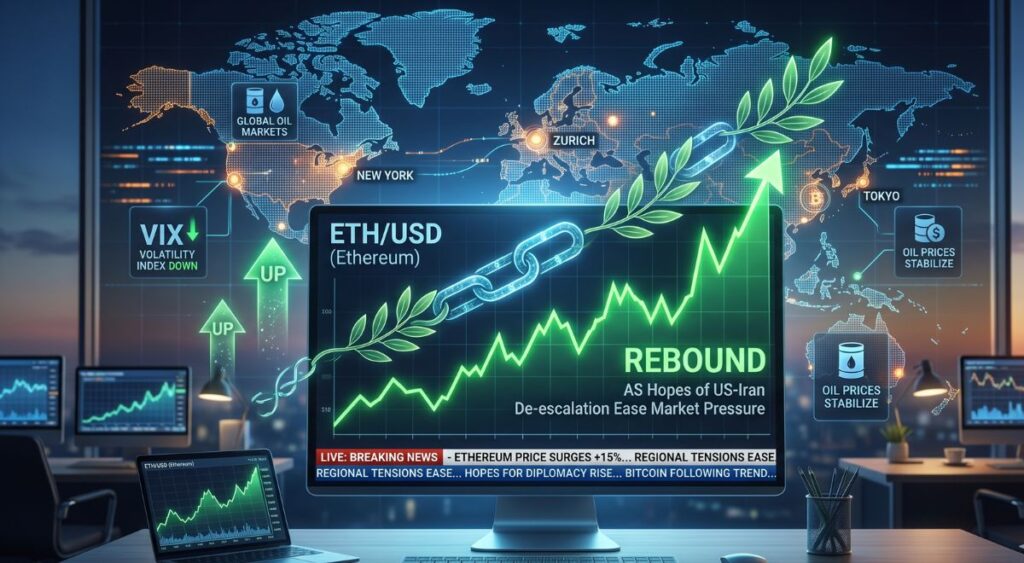
Ethereum staged a modest recovery as easing geopolitical tensions between the United States and Iran pushed oil prices and US Treasury yields lower, improving sentiment across risk assets, including cryptocurrencies.
Growing optimism surrounding diplomatic negotiations between Washington and Tehran helped cool fears of a wider regional conflict. According to reports, US President Donald Trump said talks with Iran were nearing a final stage, triggering a decline in both energy prices and bond yields. The benchmark US 10-year Treasury yield fell 8.2 basis points to 4.58%, while Brent crude futures dropped 5.63% to settle at $105.02 per barrel. Iranian authorities, however, have yet to publicly confirm any breakthrough in negotiations.
The softer macro backdrop briefly supported digital assets, with Ethereum climbing 0.96% to close near $2,125 as investors cautiously returned to higher-risk markets. Analysts note that periods of reduced geopolitical uncertainty often encourage capital flows into volatile assets such as cryptocurrencies in search of stronger returns.
Despite the rebound, Ethereum’s broader technical structure remains fragile. The cryptocurrency continues to trade below its key 200-day Simple Moving Average (SMA), a level widely viewed by traders as an indicator of long-term market direction. Current price action also suggests ongoing consolidation, with Ethereum trapped inside a narrow triangular range that has persisted for nearly three months.
Market analysts identify the $2,400 level as the first major resistance barrier. A decisive breakout above that zone could open the path toward $2,550, where the declining 200-day SMA currently sits. Reclaiming that level would be essential for restoring a stronger bullish outlook.
On the downside, the psychologically important $2,000 support remains under close watch. A sustained break below that threshold could expose Ethereum to deeper losses toward the $1,800 region, which traders consider a critical structural support level.
Momentum indicators continue to paint a cautious picture. The MACD indicator is drifting below the zero line, signalling weakening momentum, while the Relative Strength Index (RSI) is approaching oversold territory, suggesting markets remain vulnerable to further volatility.
Although easing tensions in the Middle East may temporarily relieve pressure on global energy markets, economists warn that inflation risks remain persistent. Central banks worldwide continue to grapple with sticky price pressures, increasing the likelihood that interest rates could remain elevated for longer than expected.
Such a prolonged higher-rate environment may ultimately limit upside momentum for cryptocurrencies and other speculative assets as investors continue to navigate an uncertain global economic landscape.