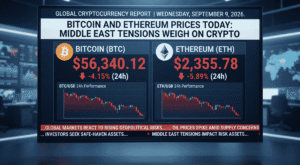

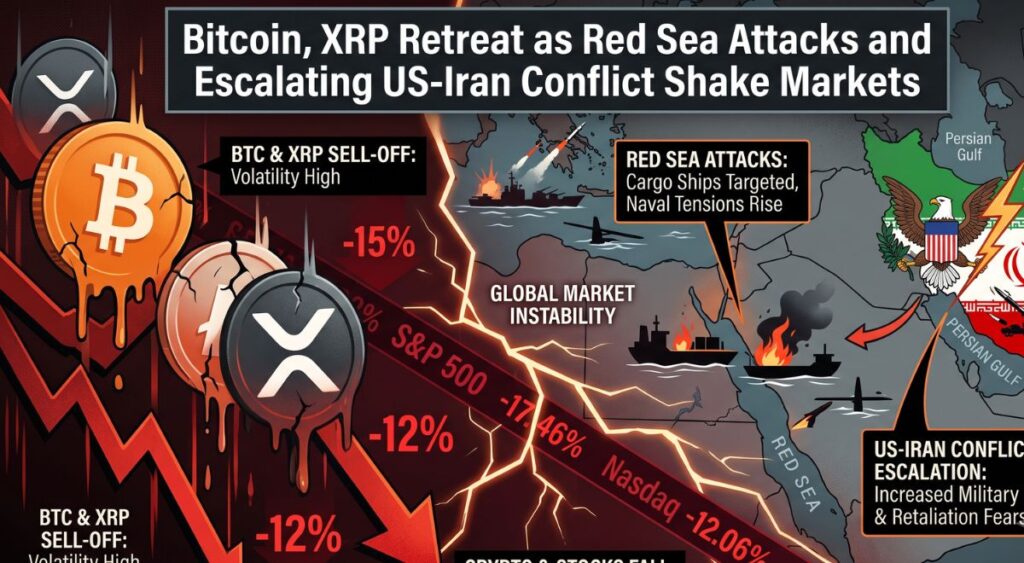
Bitcoin and XRP came under renewed selling pressure on Wednesday as escalating tensions in the Middle East rattled global financial markets. Fresh attacks on oil tankers in the Red Sea, coupled with continued military exchanges between the United States and Iran, pushed crude oil prices higher, fueling concerns over energy supply disruptions and inflation.
According to reports, Yemen’s Iran-backed Houthi movement launched coordinated attacks on two Saudi oil tankers in the Red Sea using ballistic missiles, cruise missiles, and drones. The group also claimed responsibility for intercepting several commercial vessels transiting the strategic waterway.
Saudi authorities confirmed that a Saudi-owned commercial vessel was struck during the incident, resulting in a fire onboard. While all crew members were reported safe, officials condemned the attack as a violation of international maritime law and warned of growing security risks in one of the world’s busiest shipping routes.
The Houthis also announced the immediate enforcement of a naval blockade targeting Saudi Arabia, raising concerns over further disruptions to regional energy exports. The attacks came as Saudi Arabia and the United States signed a long-term nuclear cooperation agreement aimed at expanding collaboration in civilian nuclear energy.
Meanwhile, military tensions continued to escalate as U.S. Central Command carried out another round of strikes on Iranian military infrastructure, marking the twelfth consecutive night of operations. The strikes reportedly targeted missile and drone facilities, maritime assets, coastal surveillance systems, and air defense installations. President Donald Trump also warned that additional attacks would follow any Iranian action against vessels in the Strait of Hormuz.
The intensifying conflict has heightened fears of supply disruptions across both the Red Sea and the Strait of Hormuz, two critical routes for global crude exports. Brent crude climbed above $88 per barrel, extending gains of more than 31% since the beginning of July as traders priced in increasing geopolitical risk.
The surge in energy prices also weighed on broader financial markets. The U.S. Dollar Index (DXY) slipped below 101.71 amid rising inflation concerns, while the benchmark 10-year U.S. Treasury yield approached 4.70%, its highest level in more than a year.
Higher Treasury yields and renewed risk aversion prompted investors to reduce exposure to cryptocurrencies, with Bitcoin and XRP surrendering recent gains as capital shifted toward traditional safe-haven assets. Analysts say continued geopolitical uncertainty and elevated oil prices could keep digital assets under pressure until markets gain greater clarity on the conflict’s trajectory.