

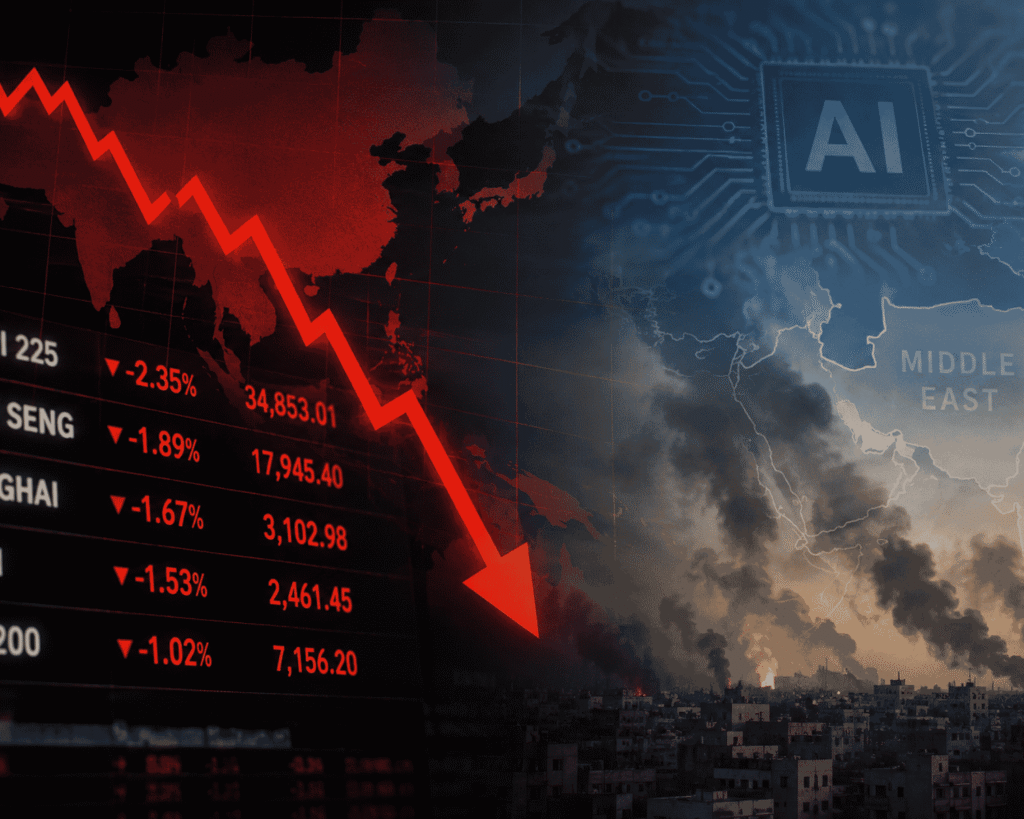
Asian stock markets were mostly lower on Tuesday as investors turned cautious over elevated valuations in artificial-intelligence-related companies and ongoing tensions in the Middle East. At the same time, Bitcoin extended its recent rally, rising above $80,000 as some investors increasingly view the cryptocurrency as a potential hedge against dollar-related risks.
The weakness across much of Asia followed an overnight decline in U.S. equities, where technology and semiconductor stocks came under pressure ahead of Nvidia’s upcoming earnings report. Chipmakers, memory companies and other firms tied to AI infrastructure were among the biggest decliners in the S&P 500 on Monday.
South Korea’s Kospi slipped 0.2%, with major semiconductor companies SK Hynix and Samsung Electronics falling 1.6% and 1%, respectively. Hong Kong’s Hang Seng Index declined 0.25%, while China’s Shanghai Composite edged down 0.1% and Taiwan’s Taiex lost 0.2%.
Japan’s Nikkei Stock Average bucked the regional trend, gaining 0.4% after recovering from earlier losses. Singapore’s FTSE Straits Times Index also advanced 0.4%.
Commerzbank Research analysts said renewed pressure on technology and semiconductor stocks was the main feature of the session. Investors are becoming more cautious ahead of Nvidia’s earnings update, which could provide a fresh test of whether strong AI demand is sufficient to justify current valuations and expected investment returns.
Oil Markets Focus on New Iran Measures
Oil prices were mixed as traders assessed new U.S. measures targeting Iran.
U.S. Treasury Secretary Scott Bessent said Monday that Washington was beginning a new campaign aimed at isolating the Iranian regime. He said the Treasury Department had identified networks involved in helping Iran evade sanctions, generate oil revenue and obtain technology linked to its nuclear and missile programs.
More than 60 entities, individuals and vessels around the world were targeted, according to Bessent. The measures cover areas including digital assets, technology, gold, aviation and shipping.
Joseph Capurso, head of foreign exchange, international and geoeconomics at Commonwealth Bank of Australia, said the latest U.S. campaign could create additional pressure on international trade. He noted that China remains Iran’s largest trading partner and is unlikely to fully comply with U.S. demands to halt commerce with Tehran.
Capurso also warned that escalating U.S. pressure on Iran could create risks for the existing trade truce between Washington and Beijing ahead of a planned leaders’ meeting next month.
Front-month West Texas Intermediate crude futures rose 0.1% to $85.13 a barrel, while Brent crude futures were little changed at $92.17 a barrel, according to ICE data.
Bitcoin Extends Rally Above $80,000
Bitcoin continued its strong recent performance, climbing nearly 3% to around $81,238, its highest level since May 15. The move extended a weeklong rally that has lifted the cryptocurrency by roughly 25%.
Bitcoin was most recently trading about 1.7% higher at approximately $80,280, according to LSEG.
The cryptocurrency’s advance comes as some investors increasingly look to digital assets as an alternative store of value and potential hedge against weakness in the U.S. dollar. Meanwhile, traditional markets remain focused on the outlook for AI-related investments, geopolitical risks and the potential impact of further sanctions on global trade and energy markets.