
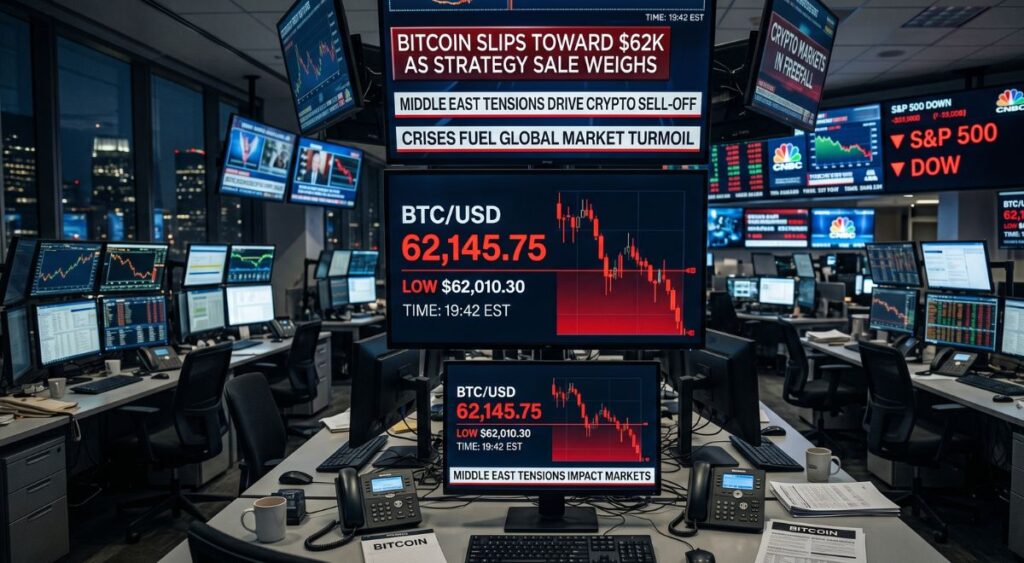
The cryptocurrency market remained under pressure this week, with Bitcoin falling toward the $62,000 mark as investors reacted to a combination of corporate selling activity, geopolitical uncertainty, and shifting market sentiment.
Bitcoin Faces Renewed Selling Pressure
Bitcoin (BTC) briefly touched the $62,000 level before stabilizing. As of June 5, the world’s largest cryptocurrency was trading at $62,592, down more than 2% over the previous 24 hours.
A key factor behind the decline was the unexpected sale of Bitcoin by software firm Strategy. According to reports, the company sold 32 BTC worth approximately $2.5 million between May 26 and May 31. While the transaction represented only a small portion of its holdings, the move attracted attention because Strategy has long been regarded as one of Bitcoin’s strongest long-term supporters.
The sale marked only the second time the company has reduced its Bitcoin position since the collapse of FTX in 2022. Strategy recently indicated it may consider future sales if doing so helps improve shareholder value and strengthen its balance sheet, signaling a more flexible approach to its treasury management strategy.
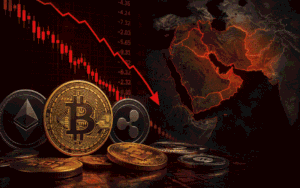
Adding to market concerns were escalating tensions in the Middle East. Reports that Iran’s Islamic Revolutionary Guard Corps targeted U.S. military bases in Kuwait and Bahrain raised fears of a broader regional conflict. Investors worried that disruptions around the Strait of Hormuz could threaten global oil supplies and increase inflationary pressures, prompting a move away from risk assets such as cryptocurrencies.
Despite the market weakness, regulatory developments in the United States provided some optimism. The U.S. Securities and Exchange Commission (SEC) recently identified digital assets and blockchain technology as key priorities in its 2026–2030 strategic plan. The agency signaled plans to create clearer regulations for tokenized assets, crypto custody, staking services, and blockchain-based financial infrastructure.
The SEC’s evolving stance is being viewed as part of a broader effort to integrate digital assets into the traditional financial system. President Donald Trump has also reiterated his goal of making the United States a global hub for cryptocurrency innovation, while SEC Chair Paul Atkins has emphasized the need for a more innovation-friendly regulatory environment.
Market analysts remain divided on Bitcoin’s next move. Trade Nation analyst David Morrison warned that Bitcoin could revisit the $60,000 level if it remains below $65,000 for an extended period. Others believe the recent selling may indicate the later stages of a bear market, pointing to increased capitulation among investors who purchased Bitcoin at significantly higher prices.
Ethereum Falls Below $1,800 Amid ETF Outflows and Whale Selling
Ethereum (ETH) continued its downward trend, slipping below the important $1,800 threshold. The second-largest cryptocurrency was trading around $1,734 on June 5, representing a daily decline of more than 3.5%.
Weak institutional demand has been a major contributor to Ethereum’s struggles. U.S. spot Ethereum ETFs recorded net outflows of nearly $53 million by June 3, with BlackRock’s ETHA fund accounting for the vast majority of withdrawals. The fund has now experienced 17 consecutive trading days of outflows.
Some analysts believe institutional capital is increasingly moving toward emerging sectors such as artificial intelligence-linked tokens and the fast-growing Hyperliquid ecosystem. Recent trading data suggests investors are diversifying away from traditional crypto leaders like Bitcoin and Ethereum.
Large-scale investors have also added selling pressure. Blockchain analytics platform Arkham reported that long-time investor James Fickel transferred approximately 10,000 ETH, valued at around $18.6 million, to Coinbase. Another early Ethereum holder has reportedly sold roughly 60,000 ETH and 9,400 wsETH in recent months, generating total sales worth approximately $146 million.
Despite these challenges, some companies continue to expand their Ethereum exposure. Digital asset treasury firm BitMine announced plans to raise up to $300 million through a preferred stock offering. The proceeds will be used primarily to increase its Ethereum holdings, mirroring Strategy’s Bitcoin acquisition model.
Analysts remain split on Ethereum’s outlook. Crypto analyst Ali Martinez believes a break below key support could send ETH toward $1,500. In contrast, Standard Chartered’s Geoffrey Kendrick maintains a bullish long-term view, forecasting Ethereum could outperform Bitcoin and potentially reach $4,000 by the end of 2026.
XRP Slides as Investors Reduce Exposure
XRP joined the broader market downturn, falling toward $1.10 during the week. The token was trading near $1.14 on June 5, down almost 6% over the previous day.
Signs of weakening demand are emerging across both retail and institutional markets. Futures open interest fell from nearly $3 billion at the beginning of the week to approximately $2.59 billion, indicating that leveraged traders are reducing exposure.
The decline triggered significant liquidations, with roughly $18.6 million in bullish positions wiped out after XRP fell below $1.25. By comparison, short liquidations remained relatively limited, highlighting the market’s bearish sentiment.
Institutional demand has also softened. Spot XRP ETFs recorded net outflows of $5.34 million on June 3, ending a streak of positive inflows that had persisted since late April.
Market observers are closely watching whether XRP can reclaim the $1.20 level. Failure to do so could increase the likelihood of a move toward the psychologically important $1 threshold.
However, some analysts argue the recent decline reflects healthy deleveraging rather than a fundamental breakdown. According to CryptoQuant contributor Amar Taha, much of the reduction in futures activity was concentrated on specific exchanges, suggesting traders are simply reducing excessive leverage rather than abandoning the asset entirely.
Hyperliquid Defies Market Weakness Despite Recent Pullback
While most major cryptocurrencies struggled, Hyperliquid (HYPE) continued to stand out as one of the market’s strongest performers. Although the token retreated from recent highs and traded around $62 on June 5, it remains one of the best-performing digital assets of the past month.
Hyperliquid made headlines after briefly surpassing Solana’s token price, reaching an intraday high of $74.67. Although Solana still maintains a much larger market capitalization, the milestone was viewed by many investors as symbolic of Hyperliquid’s growing influence.
The decentralized derivatives platform has gained traction by bringing perpetual futures trading to the blockchain, an area traditionally dominated by centralized exchanges. Rapid growth in trading volume and user activity has helped the platform steadily expand its market share.
According to industry data, Hyperliquid’s share of the global perpetual futures market reached a record 6.63% last month, while monthly trading volume exceeded $62 billion. The platform’s growing usage has increased demand for the HYPE token and attracted significant institutional attention.
Recent developments include the launch of a Hyperliquid-focused staking ETF by Grayscale. Several research firms have highlighted Hyperliquid as one of the strongest success stories of the current crypto cycle, with some long-term projections placing the token above $140 by 2031.
Nevertheless, volatility remains a concern. On June 4, BitMEX co-founder Arthur Hayes reportedly sold his entire Hyperliquid position, triggering a sharp intraday decline of more than 15%. The move underscored the risks of profit-taking following the token’s impressive rally.
Market Outlook
Cryptocurrency markets remain caught between supportive regulatory developments and growing macroeconomic uncertainty. While clearer U.S. regulations and rising institutional adoption continue to strengthen the long-term investment case for digital assets, geopolitical risks and ongoing profit-taking are keeping short-term sentiment fragile.
For now, investors are closely watching whether Bitcoin can hold above $60,000, Ethereum can defend key support levels, and Hyperliquid can maintain its momentum amid increasing volatility.