

New York Federal Reserve President John Williams has warned that escalating conflict in the Middle East is pushing US inflation higher through rising energy costs, while renewed market volatility is rippling across the $2.5 trillion cryptocurrency sector.
Speaking in an interview with Bloomberg, Williams said the ongoing US-Israel conflict involving Iran is already driving up oil prices and feeding directly into headline inflation, though he believes the impact will be temporary over the longer term.
“Energy prices are an important component” of inflation, Williams said, adding that the surge in oil and fuel costs is expected to keep headline inflation elevated through the middle of the year. He projected inflation could finish 2026 at around 2.75%, while cautioning that it may climb above 3% in the near term if supply disruptions worsen.
The comments come as concerns grow over disruptions to global oil flows linked to tensions around the Strait of Hormuz, a critical shipping route that handles a major share of the world’s crude exports.
Energy prices emerge as key inflation driver
Williams maintained that underlying inflation pressures remain more contained, with core inflation — which excludes food and energy — expected to stay near 2.5% this year. That suggests most of the current inflationary pressure is being driven by oil and refined fuel costs rather than stronger consumer demand.
In separate remarks reported by Investing.com, Williams said developments in the Middle East were causing “significant increases in energy prices,” adding that inflation could remain “well above 3%” over the coming months as the shock spreads through the broader economy.
The World Bank has also warned that energy markets may remain under pressure into 2026. In its latest projections, the institution estimated global energy prices could rise by as much as 24% next year, potentially reaching their highest levels since Russia’s invasion of Ukraine in 2022.
Crypto markets slide as oil prices surge
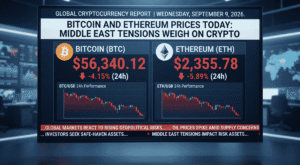
The sharp rise in oil prices has also unsettled cryptocurrency markets, with investors increasingly concerned that persistent inflation could force the Federal Reserve to maintain tighter monetary policy for longer.
Recent reports from crypto.news noted that Brent crude briefly climbed above $100 per barrel amid fears that disruptions in the Strait of Hormuz could impact nearly 20% of global oil supply. The surge intensified inflation concerns and triggered renewed selling pressure across digital assets.
Bitcoin fell below the $70,000 mark during the selloff, while major cryptocurrencies including Ethereum, BNB, XRP, Solana and Dogecoin recorded daily losses between 2% and 4%.
Market analysts are also warning that US inflation readings could accelerate sharply in the months ahead. Economists cited by crypto.news expect monthly headline CPI figures to rise as high as 0.9% month-on-month, driven largely by energy costs tied to the Iran conflict.
At the same time, the Federal Reserve has signaled that interest rates are likely to remain elevated between 3.50% and 3.75%, with policymakers increasingly concerned that oil-driven inflation could keep broader price measures near 3%.
Federal Reserve adopts tougher tone
Williams’s reassurance that monetary policy remains “in the right place” contrasts with increasingly hawkish signals from other Federal Reserve officials as the conflict continues.
Federal Reserve Governor Christopher Waller recently warned that inflation risks are intensifying again after April consumer price data reportedly showed inflation reaching 3.8% year-on-year, with energy prices surging nearly 18% as oil climbed back above $100 per barrel.
Waller said additional rate hikes could return to the table if inflation fails to ease in the coming months, reinforcing investor concerns that prolonged geopolitical instability may keep financial markets under pressure well into 2026.