
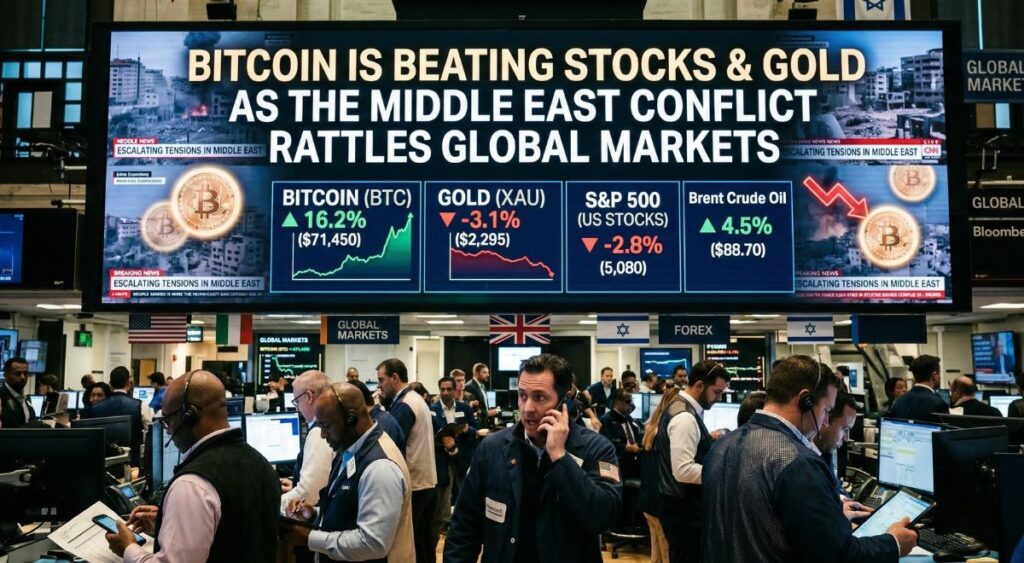
As geopolitical tensions escalate across the Middle East, global financial markets are experiencing renewed volatility. Traditionally, investors turn to safe-haven assets during periods of uncertainty. However, in the current environment, Bitcoin is emerging as one of the strongest performers, outpacing both equities and traditional hedges like Gold.
Rising Uncertainty in Global Markets
The latest wave of instability in the Middle East has heightened concerns about energy supply disruptions, inflation pressures, and broader economic uncertainty. Conflicts in the region often influence oil prices, trade routes, and investor confidence, which in turn ripple through global financial markets.
Major stock markets have reacted cautiously. The S&P 500 and other global equity indices have experienced fluctuations as investors reassess risk exposure. In times like these, capital often shifts toward assets perceived as stable or independent from traditional financial systems.
Bitcoin’s Safe-Haven Narrative Strengthens
During the recent turmoil, Bitcoin has demonstrated surprising resilience. While historically viewed as a highly volatile asset, the cryptocurrency has increasingly been treated by some investors as a digital hedge against macroeconomic instability.
Several factors are contributing to Bitcoin’s strength:
- Decentralization: Unlike traditional financial assets, Bitcoin operates outside government and central bank control.
- Limited Supply: With a fixed supply cap of 21 million coins, Bitcoin is often compared to digital gold.
- Global Accessibility: Investors worldwide can quickly move capital into Bitcoin during periods of uncertainty.
As a result, demand for Bitcoin has increased while riskier assets face selling pressure.
Gold Faces New Competition
For decades, gold has been considered the ultimate safe-haven asset during geopolitical crises. However, Bitcoin’s recent performance suggests that younger investors and institutions are beginning to view digital assets as an alternative store of value.
While gold remains stable and widely trusted, Bitcoin’s higher potential returns and liquidity in the digital economy have drawn significant capital inflows. Some analysts now describe Bitcoin as “digital gold,” reflecting its growing role in global portfolios.
Institutional Interest Fuels Momentum
Institutional adoption is another key factor behind Bitcoin’s rise. Large investment funds, fintech platforms, and even some publicly traded companies have increased their exposure to cryptocurrency. This growing acceptance has improved market liquidity and strengthened investor confidence.
Additionally, financial products such as Bitcoin ETFs and regulated crypto exchanges have made it easier for traditional investors to gain exposure without directly holding cryptocurrency.
A Changing Financial Landscape
The current market reaction highlights a broader shift in the global financial system. While traditional assets like stocks and gold remain essential components of diversified portfolios, digital assets are increasingly influencing market dynamics.
As geopolitical tensions persist, Bitcoin’s performance during this crisis could further reinforce its role as a hedge against global instability.
Looking Ahead
Despite its recent gains, Bitcoin remains volatile and sensitive to regulatory developments, market sentiment, and macroeconomic trends. Investors are likely to continue balancing digital assets with traditional safe havens.