
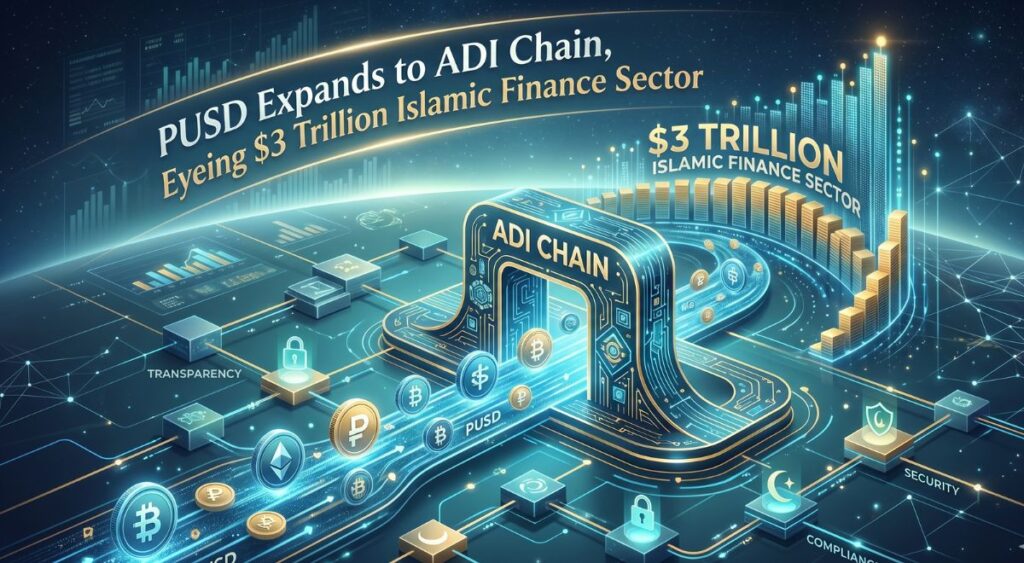
Palm Azgar Finance is moving to deepen its footprint in the Middle East’s fast-evolving digital asset landscape, announcing that its Shariah-compliant stablecoin, PUSD, will integrate with ADI Chain — a layer-2 blockchain designed for institutional settlement across the region.
The deployment introduces PUSD as the second stablecoin on ADI Chain, a network initially built to support a dirham-backed digital currency. With an estimated circulating supply of $2.3 billion, PUSD is fully backed on a 1:1 basis by reserves held in Saudi riyals and UAE dirhams, both pegged to the U.S. dollar.
Already active on major blockchain networks including Ethereum, BNB Chain, Solana, and Tron, the stablecoin’s integration with ADI Chain broadens institutional access, particularly within the Gulf and neighboring markets.
ADI Chain itself was developed as a settlement layer for a dirham-pegged stablecoin initiative backed by International Holding Company and First Abu Dhabi Bank. The project has received licensing from the Central Bank of the UAE, positioning the network as a regulated infrastructure capable of supporting both dollar-linked and dirham-denominated digital assets.
Designed to facilitate cross-border settlement corridors linking the Gulf, wider Middle East, and parts of Africa, ADI Chain allows transactions to be processed using its native token for fees. PUSD, however, is not aimed at retail adoption; instead, it targets institutional users such as corporate treasuries, crypto exchanges, and payment processors.
The launch comes as Islamic finance — a sector governed by Shariah principles prohibiting interest — continues to expand globally. According to the ADI Foundation, total Islamic finance assets now exceed $3 trillion. PUSD is structured to align with these principles, offering a blockchain-based settlement tool without reliance on interest-bearing mechanisms.
The United Arab Emirates has rapidly built out a layered regulatory framework for digital assets, with both the Central Bank of the UAE and Abu Dhabi Global Market issuing distinct rules governing stablecoins and virtual asset providers.
Momentum in the sector has accelerated in recent months. Telecom giant e& partnered with Al Maryah Community Bank to pilot a dirham-backed stablecoin for consumer payments. Meanwhile, RAKBank has secured in-principle approval to issue its own token, pending final regulatory clearance.
Elsewhere, Universal Digital launched USDU in January — a dollar-backed stablecoin registered under the UAE’s Payment Token Services Regulation — marking the first such token approved for payment use under the framework. The Financial Services Regulatory Authority has also granted approvals within ADGM to major players including Tether, Ripple (for Ripple USD), and Circle.
With regulatory clarity improving and institutional infrastructure taking shape, PUSD’s expansion onto ADI Chain underscores a broader push to bridge Islamic finance with blockchain-based settlement systems — a convergence that could redefine cross-border transactions in the region.