
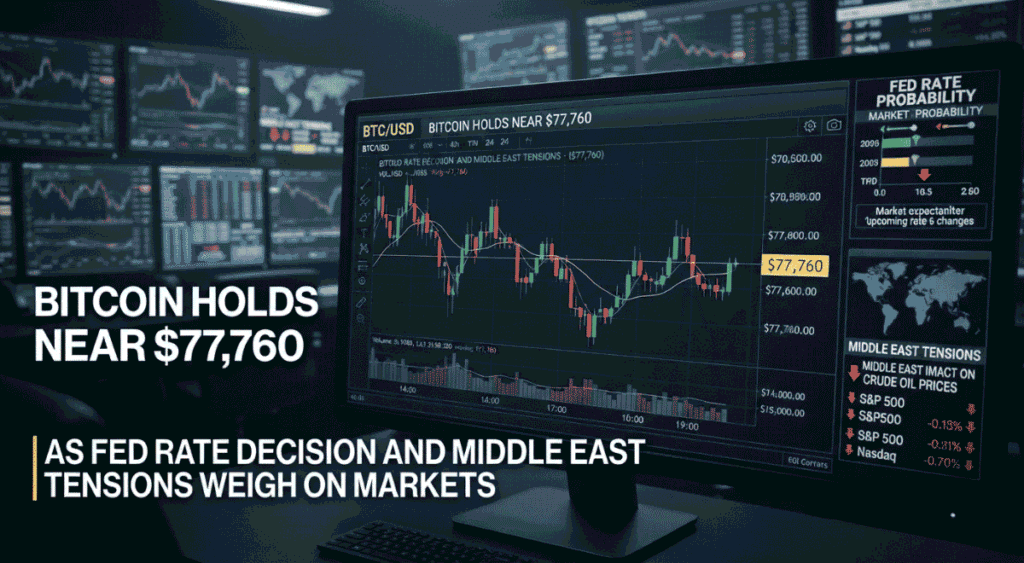
Bitcoin remained close to $77,760 as investors assessed rising geopolitical tensions in the Middle East, higher oil prices and growing uncertainty ahead of the U.S. Federal Reserve’s upcoming interest-rate decision.
The cryptocurrency has shown resilience despite renewed pressure across risk-sensitive markets as developments involving the United States, Iran and Yemen’s Iran-aligned Houthi movement raise concerns about disruptions to global energy and shipping routes.
Middle East tensions drive oil prices higher
Oil prices have climbed as tensions surrounding key shipping routes in the Middle East intensify. The standoff involving the United States and Iran over the Strait of Hormuz has added to concerns about energy supplies, while Houthi attacks targeting Saudi Arabia and shipping activity around the Bab al-Mandab Strait have introduced another source of risk.
Analysts estimate that continued disruptions could put an additional 4% to 5% of global oil supplies at risk. The prospect of tighter energy markets has helped push Brent crude above $107 a barrel, reinforcing concerns that higher energy costs could keep inflation elevated.
For financial markets, the combination of expensive oil and persistent inflation creates an uncomfortable backdrop. If inflation remains elevated, central banks could face greater pressure to maintain or raise interest rates, potentially weighing on assets such as Bitcoin that tend to perform better in easier monetary conditions.
The U.S. 10-year Treasury yield is also trading near 4.97%, reflecting continued pressure in the bond market and adding to the broader inflation and interest-rate concerns.
Fed decision becomes a key focus for Bitcoin
Investors are now turning their attention to the Federal Reserve’s monetary policy decision, with markets increasingly expecting a 25-basis-point rate hike at the upcoming meeting.
According to market estimates cited by Coinpedia, traders were assigning an 86% probability to a quarter-point increase. Several Federal Reserve officials have also highlighted concerns about inflation remaining persistent, increasing the importance of the central bank’s guidance for financial markets.
Higher interest rates generally create a more challenging environment for cryptocurrencies because they can increase the appeal of traditional yield-bearing assets while reducing demand for speculative investments.
Bitcoin’s recent performance has also coincided with a change in institutional demand. U.S. spot Bitcoin ETFs attracted approximately $3.34 billion between August 19 and September 4, helping fuel a move from around $62,000 to nearly $82,000.
However, the trend weakened afterward. The final four trading sessions before September 14 recorded combined ETF outflows of roughly $462.7 million, suggesting that institutional buying momentum may be cooling as Bitcoin trades at higher levels.
On-chain indicators provide a somewhat more constructive signal. Glassnode’s Sell-Side Risk Ratio has fallen to around 7 basis points per day from approximately 16 basis points at its August peak. Long-term holders were responsible for about 47% of realized profits, compared with 88% in August.
The decline suggests that longer-term Bitcoin holders may be showing less willingness to sell into the current market, potentially limiting additional selling pressure.
Clarity Act adds another layer of uncertainty
Beyond monetary policy and geopolitical developments, cryptocurrency investors are also monitoring the U.S. Congress as lawmakers consider the future of the Clarity Act.
Pro-crypto lawmakers have pushed for a vote on the long-delayed legislation, but uncertainty remains over whether the bill can secure the 60 votes required to advance. Debate has continued over provisions involving stablecoin yields and ethical restrictions that could limit government officials’ ability to invest in digital assets.
The legislation has gained some momentum following the release of a revised version by Senate Republicans. Polymarket data cited by Coinpedia placed the probability of the Clarity Act becoming law in 2026 at 31%.
A successful vote could provide greater regulatory clarity for the cryptocurrency industry, while another delay could extend the uncertainty surrounding the U.S. digital-asset market.
Bitcoin technical levels remain in focus
With several major catalysts approaching, traders are closely watching Bitcoin’s key support levels.
The $76,600 area is emerging as an important near-term support zone. A sustained break below that level could increase the risk of a move toward the deeper $71,000 support area.
Conversely, Bitcoin’s ability to hold above $76,600 despite geopolitical pressure, elevated oil prices and uncertainty around U.S. monetary policy could indicate underlying market strength.
For now, Bitcoin remains caught between supportive long-term holder behavior and a more difficult macroeconomic environment. The Federal Reserve’s rate decision, ETF flows, developments in the Middle East and progress on U.S. crypto legislation could determine the cryptocurrency’s next major move.