
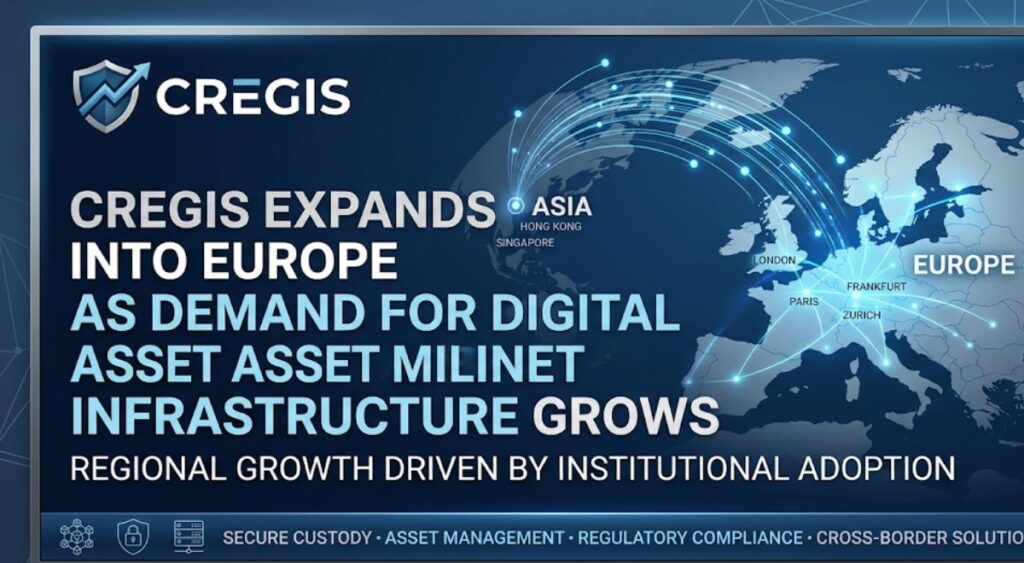
Digital asset infrastructure provider Cregis is accelerating its expansion across Europe, building on its established presence in the Asia-Pacific and Middle East regions. The move comes amid rising demand for compliant stablecoin payment solutions and institutional-grade digital asset operations.
The company recently increased its visibility in Europe through participation in major industry events, including Paris Blockchain Week, Money20/20 Europe, and iFX Expo International Cyprus.
Founded in 2017, Cregis provides digital asset infrastructure services to financial institutions, payment service providers, forex brokers, fintech companies, and Web3 firms. The company says it now serves more than 4,000 enterprise clients across over 50 countries and has processed more than $300 billion in transaction volume.
Before targeting Europe, Cregis spent several years building its business across the Asia-Pacific region, refining its infrastructure through large-scale enterprise deployments. That operational experience later supported its expansion into the Middle East.
In 2024, the company established its regional headquarters in Dubai, leveraging the UAE’s position as a gateway between Europe, Africa, South Asia, and the CIS region. Since then, Cregis has expanded its local workforce, strengthened compliance operations, and increased engagement with regional regulators.
According to the company, its Middle East operations have become profitable, serving more than 150 enterprise customers, including GTCFX. Cregis has also expanded its presence within the brokerage and payments sectors across Dubai and Cyprus.
Europe is increasingly viewed as a key market for institutional digital asset adoption, particularly as the implementation of the Markets in Crypto-Assets Regulation (MiCA) provides greater regulatory clarity. At the same time, growing interest in cross-border payments, treasury automation, and stablecoin settlements is driving financial institutions to explore new infrastructure solutions.
“Across Europe, we’re seeing a clear shift from experimentation to implementation,” said Shawn Yan, founder and CEO of Cregis. He noted that institutions are increasingly focused on integrating digital asset payments, treasury management, and custody services into existing financial systems.
Unlike providers that focus primarily on custody services, Cregis offers a broader infrastructure platform that combines digital wallets, payment orchestration, treasury management, and compliance tools. The company says its system enables businesses to customize approval processes, access controls, treasury structures, and payment workflows to suit operational needs.
The platform also includes risk management features, governance controls, and audit-ready reporting capabilities designed to help enterprises meet regulatory and internal compliance requirements.
As stablecoins gain traction as payment tools rather than solely trading assets, Cregis expects payment infrastructure to become one of the fastest-growing areas of the digital asset industry. Its Payment Engine is designed to facilitate collections, payouts, settlements, and treasury operations across multiple blockchain networks and jurisdictions, helping businesses streamline global financial transactions.