
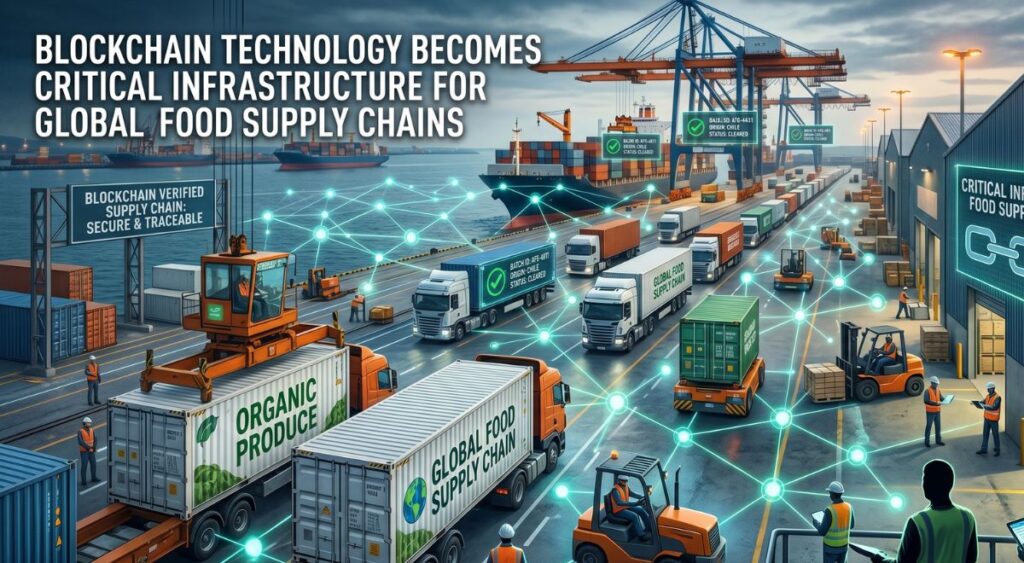
The global market for blockchain technology in food supply chains is entering a new phase of growth, driven by stricter food safety regulations, rising demand for supply chain transparency, and lower implementation costs enabled by cloud-based platforms.
Industry analysts say the sector is moving beyond experimental pilot projects and into large-scale commercial adoption, positioning blockchain as a core component of modern food industry infrastructure. Regulatory deadlines, particularly the implementation of the US Food and Drug Administration’s Food Safety Modernization Act (FSMA) Rule 204 and the European Union’s Farm-to-Fork Strategy, are accelerating investment in digital traceability systems across global food networks.
Food Safety Concerns Fuel Adoption
Foodborne illnesses remain a major challenge for governments and food producers worldwide. According to the World Health Organization, around 600 million people suffer from foodborne diseases annually, resulting in approximately 420,000 deaths each year.
The financial impact is equally significant. Food recalls cost the US food industry an estimated $10 billion annually, while individual recall events can generate direct expenses of roughly $10 million. Traditional paper-based tracking systems often require days or even weeks to identify contamination sources, increasing both financial losses and reputational damage.
Blockchain technology is increasingly viewed as a solution because it creates an immutable, time-stamped record of every transaction across the supply chain. This allows companies to identify affected product batches within minutes, significantly reducing recall response times and limiting inventory losses.
Regulatory Pressure Creates New Market Opportunities
Government regulations are emerging as one of the strongest catalysts for blockchain adoption in food traceability.
The FDA’s FSMA Rule 204, which applies to high-risk food categories such as leafy greens, shell eggs, nut butters and fresh-cut produce, began phased enforcement in January 2026. Compliance requirements will gradually extend to smaller food businesses in the coming years.
In Europe, the Farm-to-Fork Strategy is establishing long-term digital traceability goals through 2030. The EU Deforestation Regulation, which came into force in 2025, also requires companies importing commodities such as cocoa, soy, beef and palm oil to demonstrate supply chain due diligence.
Major retailers including Walmart, Carrefour and Aldi are extending these requirements throughout their supplier networks, creating demand for blockchain-based tracking solutions among thousands of smaller suppliers and logistics providers.
Consumers Demand Greater Transparency
Consumer expectations are also reshaping the market.
Research indicates that supply chain transparency has become an increasingly important purchasing factor for food buyers in developed economies. Consumers are paying closer attention to product origin, sustainability claims and ethical sourcing practices.
As a result, food manufacturers are increasingly adopting blockchain-backed provenance systems that allow shoppers to access product histories through QR codes at the point of sale. These systems are becoming particularly valuable in premium food categories, where transparency can serve as a competitive differentiator.
The growing importance of environmental, social and governance (ESG) reporting is further strengthening demand. Investors are increasingly assessing food companies based on supply chain sustainability metrics, encouraging businesses to improve traceability and disclosure capabilities.
Falling Costs Expand Access
Advancements in cloud infrastructure are making blockchain deployment more affordable for businesses of all sizes.
The shift from on-premise systems to software-as-a-service (SaaS) and blockchain-as-a-service (BaaS) platforms has significantly reduced implementation costs. Industry estimates suggest that minimum deployment expenses have fallen by around 60% since 2020.
This trend is opening new opportunities in emerging markets across Latin America, Southeast Asia and Sub-Saharan Africa, where growing cloud adoption is enabling food processors and logistics operators to implement digital traceability solutions without major capital investments.
Integration Challenges Remain
Despite strong growth prospects, several obstacles continue to slow adoption.
One of the biggest challenges is integrating blockchain platforms with existing enterprise systems such as Enterprise Resource Planning (ERP), Warehouse Management Systems (WMS) and Manufacturing Execution Systems (MES). Many of these legacy technologies were not designed to operate with distributed ledger architectures.
For many companies, the cost of integrating systems can exceed the cost of the blockchain platform itself, particularly for mid-sized organizations with limited technology budgets.
Data Standards Present Additional Hurdles
The effectiveness of blockchain traceability depends heavily on consistent data collection across all participants in the supply chain.
Food supply chains often involve hundreds of stakeholders, including farmers, processors, logistics providers, customs agencies and retailers, many of whom use incompatible data standards and documentation methods.
Industry experts argue that broader adoption of international standards such as GS1 EPCIS 2.0 will be essential to ensure interoperability between blockchain networks and prevent the creation of isolated data silos.
Cross-border supply chains face additional complexity due to varying regulatory requirements and the continued use of paper-based documentation in some regions.
SMEs Face Adoption Barriers
Small and medium-sized enterprises (SMEs), which make up a large portion of global agricultural and food supply networks, continue to face significant barriers to adoption.
Limited technology budgets, insufficient digital skills and unreliable internet connectivity in rural areas remain key obstacles. Without widespread SME participation, blockchain networks risk providing incomplete visibility across supply chains.
While international development initiatives are helping improve digital infrastructure in agricultural regions, industry observers expect farm-level blockchain adoption to remain a gradual process over the coming years.
As regulatory requirements tighten and demand for transparency continues to grow, blockchain technology is expected to play an increasingly important role in shaping the future of global food supply chains, despite ongoing challenges related to integration, interoperability and digital inclusion.