
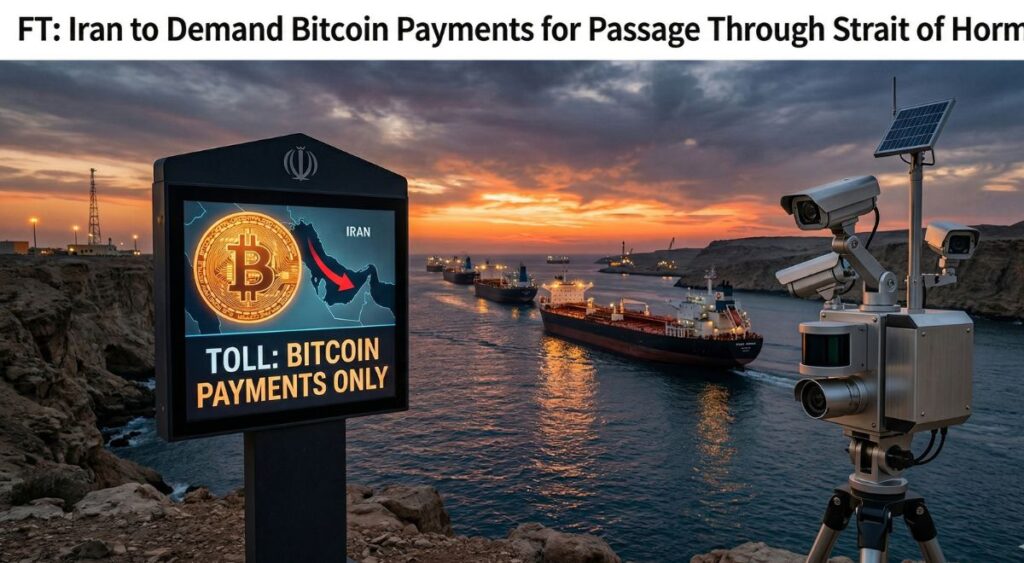
In a dramatic development reported by the Financial Times, Iran is planning to require oil tankers and shipping companies to pay transit fees in Bitcoin for passage through the strategically critical Strait of Hormuz. This move comes amid a fragile ceasefire in the ongoing 2026 Iran war and signals a major shift in how global energy trade could operate in the future.
A Strategic Waterway Under Pressure
The Strait of Hormuz is one of the most important maritime routes in the world, responsible for transporting nearly 20% of global oil supply. Any disruption in this narrow passage has immediate consequences for global energy markets, shipping costs, and geopolitical stability.
Since the escalation of conflict in early 2026, Iran has intermittently restricted access to the strait, using it as leverage against Western powers. The latest proposal to impose tolls—especially in cryptocurrency—adds a new dimension to this pressure strategy.
Why Bitcoin?
According to reports, Iran’s decision to demand payments in Bitcoin is largely driven by sanctions. Traditional financial systems are heavily monitored and controlled, making it difficult for Iran to receive payments in US dollars or other major currencies.
By using Bitcoin:
- Transactions become harder to trace or block
- Funds cannot be easily frozen by foreign governments
- Iran can bypass global banking restrictions
Officials suggest that each tanker may be required to pay a fee (reportedly around $1 per barrel) directly to an Iran-controlled crypto wallet before receiving clearance to pass.
How the System Would Work
Under the proposed system:
- Ships must pre-register cargo details with Iranian authorities
- Approval is granted for passage
- A Bitcoin payment must be sent within a short time window
- Only then is transit through the strait allowed
This effectively creates a digital toll system for one of the world’s busiest oil routes.
Global Reactions and Concerns
The proposal has sparked serious concerns across the international community:
- Energy markets: Oil prices have already shown volatility due to uncertainty around the strait
- Shipping industry: Companies fear delays, increased costs, and compliance risks
- Governments: Western nations view the move as a challenge to the global financial system
Some analysts have even described the strategy as a form of geopolitical leverage, giving Iran a powerful “economic weapon” over global trade.
Impact on the Global Financial System
If implemented, this move could have far-reaching consequences:
1. Weakening the Dollar System
The global oil trade has long been dominated by the US dollar. A shift toward Bitcoin or other currencies could challenge this system.
2. Rise of Crypto in Trade
This would mark one of the first large-scale uses of cryptocurrency in international energy transactions.
3. Increased Sanctions Evasion
Countries under sanctions may follow similar models to bypass financial restrictions.
Legal and Practical Challenges
Despite its boldness, the plan faces significant hurdles:
- International maritime law generally restricts charging fees for transit through such waterways
- Cryptocurrency volatility could complicate pricing and payments
- Limited liquidity makes Bitcoin difficult to use for large-scale oil trade
Additionally, enforcing such a system across thousands of ships daily would be operationally complex.