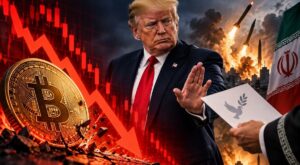

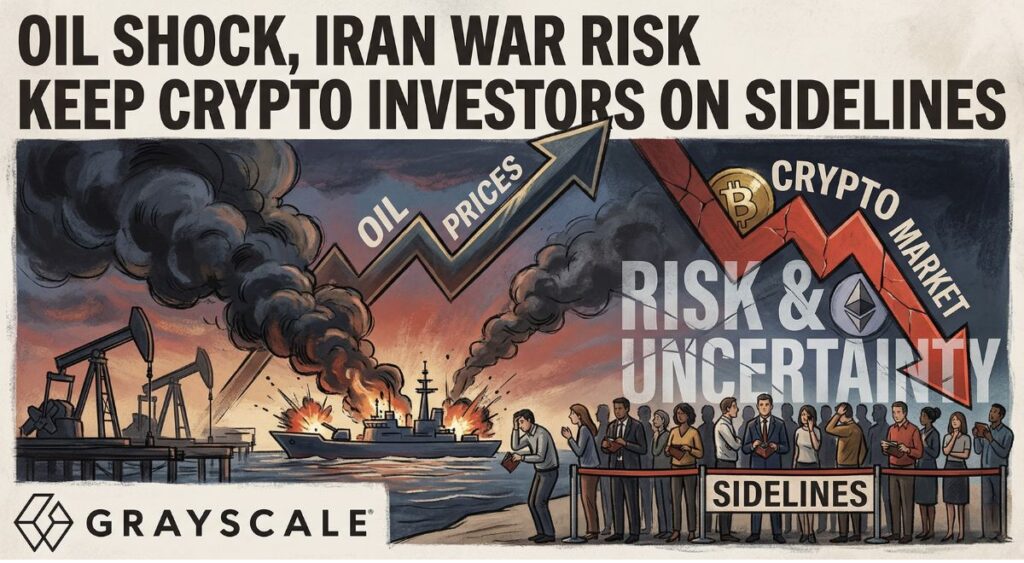
The global cryptocurrency market is facing a period of hesitation as rising oil prices and escalating geopolitical tensions in the Middle East weigh heavily on investor sentiment. According to a recent report by Grayscale, the ongoing Iran conflict has become the dominant force shaping crypto market behavior, pushing many investors into a cautious “wait-and-see” mode.
A Market Frozen by Uncertainty
Grayscale’s research highlights that the Iran war overshadowed nearly all other financial developments throughout March 2026. What had initially been a promising macroeconomic environment—characterized by improving growth and expectations of interest rate cuts—quickly deteriorated once oil prices surged.
The sharp rise in energy prices has reignited inflation concerns globally. As inflation expectations climb, central banks are less likely to cut interest rates, keeping borrowing costs higher for longer. This shift has significantly reduced appetite for risk assets like cryptocurrencies, leaving investors sidelined.
Oil Shock Ripple Effect
The impact of the conflict extends far beyond geopolitics. Oil prices have surged above $100 per barrel amid fears of supply disruptions, particularly around key routes like the Strait of Hormuz.
This “oil shock” has created a chain reaction across financial markets:
- Higher oil prices → Rising inflation
- Rising inflation → Delayed rate cuts
- Delayed rate cuts → Lower liquidity
- Lower liquidity → Weak demand for crypto
As a result, crypto assets—often treated as high-risk investments—have struggled to gain momentum despite underlying growth trends.
Bitcoin Shows Resilience Despite Volatility
Despite the challenging environment, Bitcoin has demonstrated notable resilience. Following the initial escalation of the conflict, Bitcoin dropped into the mid-$60,000 range, later rebounding toward the low $70,000s before falling again as tensions persisted.
However, on a broader scale, Bitcoin has remained relatively stable since the conflict began and has even outperformed some traditional equity markets during this period.
This suggests that while crypto remains sensitive to macroeconomic shocks, it is gradually establishing a more durable foundation.
Investors Shift to the Sidelines
Institutional and retail investors alike are adopting a cautious stance. Instead of aggressive buying, market participants are waiting for clearer signals—particularly regarding:
- Stability in oil prices
- De-escalation of the Iran conflict
- Central bank policy direction
Grayscale notes that the current environment is not defined by panic selling but by hesitation. Investors are not exiting the market entirely—they are simply delaying new exposure until uncertainty fades.
Long-Term Fundamentals Remain Strong
Despite short-term pressure, the long-term outlook for crypto remains intact. Grayscale points to several structural growth drivers:
- Rapid expansion of the stablecoin market (over $300 billion supply)
- Increasing adoption of tokenized assets
- Continued institutional participation
These factors indicate that the foundation of the crypto ecosystem is still strengthening beneath the surface volatility.
What Could Trigger a Recovery?
According to Grayscale, the key catalyst for a crypto market rebound is a reduction in macro uncertainty. If geopolitical tensions ease and oil prices stabilize, markets could quickly reprice and restore risk appetite.
However, if high energy prices persist, the pressure on inflation and interest rates may continue to delay a broader recovery across risk assets, including cryptocurrencies.