
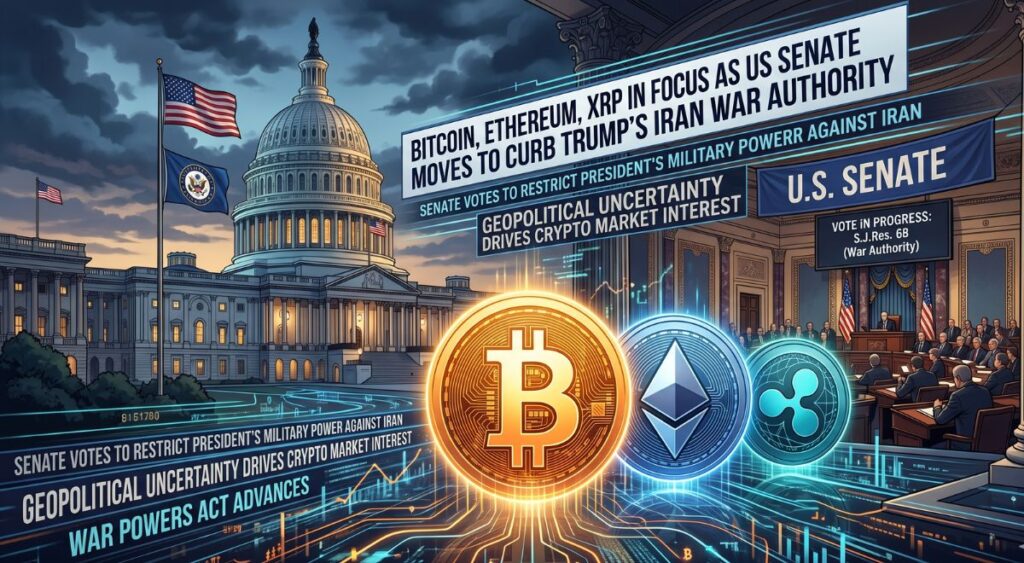
Cryptocurrency markets are watching developments in Washington after the US Senate advanced a resolution seeking to limit President Donald Trump’s authority to continue military action against Iran without congressional approval, a move that traders believe could influence sentiment across digital assets.
The Senate approved the procedural measure in a narrow 50-47 vote, with four Republican lawmakers siding with Democrats. The proposal, introduced by Democratic Senator Tim Kaine of Virginia, relies on the War Powers Act of 1973 and aims to require congressional approval for sustained military operations involving Iran.
The vote arrives as global investors remain sensitive to geopolitical tensions in the Middle East, particularly concerns over disruptions around the Strait of Hormuz, a key route for global energy shipments. Rising oil prices and higher shipping costs linked to regional instability have already pressured broader financial markets.
For crypto investors, the Senate action has introduced a new macroeconomic variable.
Over recent months, geopolitical tensions have shaped trading behavior across risk assets. Military escalations in the Middle East have repeatedly driven oil spikes, encouraged defensive market positioning, and dampened appetite for speculative investments.
During this period, Bitcoin has struggled to regain stronger momentum, while Ethereum and XRP have largely remained range-bound amid cautious investor sentiment.
De-escalation hopes could lift crypto sentiment
Some market participants view the Senate’s move as an early signal of possible de-escalation, arguing that increased political scrutiny may pressure the White House to justify any continued military engagement.
Analysts note that easing geopolitical risks often improves confidence across higher-risk markets, including cryptocurrencies.
Bitcoin, in particular, has historically reacted strongly to geopolitical headlines, with previous diplomatic breakthroughs or conflict de-escalation narratives triggering short-term relief rallies. Earlier episodes of reduced tensions in recent months reportedly sparked Bitcoin gains of between 3% and 5% as investors rotated back into riskier assets.
Ethereum’s outlook is also closely tied to liquidity conditions within decentralized finance ecosystems. Historically, periods of geopolitical uncertainty have curtailed participation in decentralized applications as investors prioritized capital preservation over yield strategies.
Reduced geopolitical stress, analysts say, has typically supported stronger on-chain activity and increased demand for Ethereum-based networks.
Meanwhile, attention remains on XRP due to its position in cross-border payment infrastructure. Heightened geopolitical instability can raise compliance concerns and create uncertainty within global banking systems, potentially slowing institutional adoption of blockchain payment solutions.
A calmer geopolitical backdrop and improved financial stability could renew institutional interest in digital settlement technologies, offering potential upside for XRP.
Tough path ahead for war powers resolution
Despite clearing an initial procedural hurdle, the resolution faces long odds of becoming law.
Although the 50-47 vote exposed some divisions within party lines, the measure must still survive Senate debate and a final vote, where maintaining support may prove difficult.
Its prospects appear even more challenging in the House of Representatives, where leadership has historically defended broad executive authority over military operations and criticized similar legislative efforts as potentially harmful to national security.
Even if the proposal secures approval in both chambers, President Trump would retain the power to veto it. Overriding a presidential veto would require a two-thirds majority in both the Senate and the House — a threshold considered highly unlikely under the current political landscape.
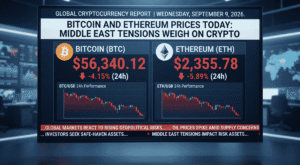
At the time of reporting, cryptocurrency markets had shown limited reaction to the development. Bitcoin traded near $77,000, posting gains of less than 1% on the day, while Ethereum and XRP recorded declines ranging from 1% to 3%.