
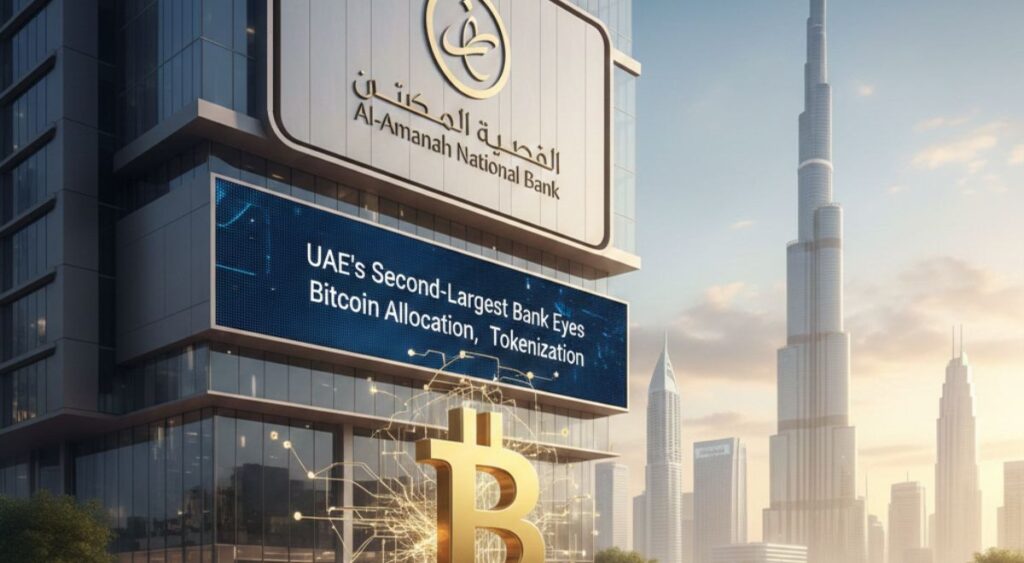
Dubai — In a notable move that underscores the growing mainstream acceptance of digital assets, Emirates NBD, the United Arab Emirates’ second-largest bank, is actively exploring the possibility of allocating a portion of its investment portfolio to Bitcoin, while also championing tokenization as a transformative force in global finance.
A Strategic Shift Toward Crypto
In a recent interview, Group Chief Investment Officer Maurice Gravier revealed that the bank has opened its investment framework to incorporate Bitcoin, though no direct purchases have yet been executed. Instead, Emirates NBD is currently building internal valuation models and risk assessments to determine a suitable exposure level.
Gravier described Bitcoin as a store of value and “digital gold,” highlighting its limited supply, strong security via proof-of-work, and low inflation characteristics — qualities that could make it a valuable strategic component in diversified portfolios. He suggested an initial allocation in the range of 0.5% to 1% for balanced investment strategies once the bank finalizes its internal review.
While the bank remains cautious due to Bitcoin’s inherent price volatility and its correlation with broader risk markets, the fact that it is strategically evaluating such an allocation reflects a broader institutional shift toward recognizing digital assets as legitimate macro financial tools rather than purely speculative instruments.
Tokenization: The Next Financial Frontier
Alongside Bitcoin allocation, Emirates NBD is also vocal about the potential of tokenization — the process of converting real-world assets into digital tokens on a blockchain. According to bank leadership, tokenized assets have the potential to deliver greater transparency, peer-to-peer trading, and reduced intermediary costs, particularly in previously illiquid markets.
The bank anticipates that tokenization will extend beyond cryptocurrencies and into private markets and traditional securities, enabling continuous liquidity and tradable pricing for assets that historically lacked efficient trading mechanisms. This aligns with broader trends in the region, where regulatory frameworks and blockchain initiatives are being designed to support innovative financial products.
Stablecoins and Remittance Flows
Gravier also pointed to the role of stablecoins — cryptocurrencies pegged to fiat currencies like the U.S. dollar — in reshaping payment rails in the UAE and the broader Middle East. With a large expatriate population relying heavily on cross-border remittances, stablecoins have seen transaction volumes that rival or exceed established payment networks. Emirates NBD sees this not just as a trend but as an important element of future payments infrastructure.
Institutional and Regional Momentum
The bank’s exploratory stance occurs against a backdrop of regional institutional involvement in digital assets. For example, the UAE’s sovereign investment entities, such as Mubadala, have already increased their Bitcoin exposure via exchange-traded funds — reflecting a broader confidence in the asset class among major institutional players.
Overall, Emirates NBD’s move signals a meaningful evolution in how traditional financial institutions in the UAE and the broader Gulf region perceive and integrate digital assets and blockchain-enabled financial technologies into their core strategies.