
Introduction
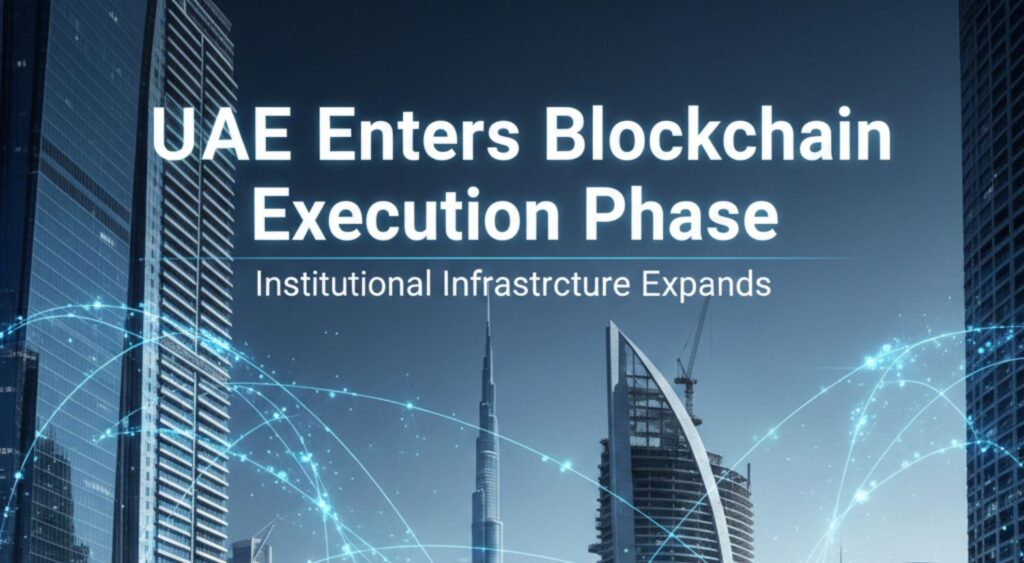
The United Arab Emirates (UAE) has officially entered a new phase in its blockchain journey, transitioning from experimentation to large-scale, regulated implementation across finance, governance, and public-sector systems. According to a flagship report released by The Blockchain Center Abu Dhabi in collaboration with Binance, blockchain technology is now being embedded as foundational economic infrastructure within the UAE’s institutional framework.
The report highlights how the country’s layered regulatory approach has accelerated institutional adoption in key areas such as payments, tokenization, custody, and market infrastructure. This strategic evolution positions the UAE as one of the world’s most advanced jurisdictions in the practical deployment of blockchain technology.
From Experimentation to National-Scale Execution
The research underscores that the UAE has moved beyond pilot projects into a full execution phase characterized by regulatory clarity, scalability, and institutional participation. Blockchain adoption is now evident in multiple live, regulated use cases across the country.
Key developments include:
- A national digital identity infrastructure serving over 11 million users.
- Multiple stablecoins approved by the Dubai Financial Services Authority (DFSA) and Abu Dhabi Global Market’s Financial Services Regulatory Authority (FSRA).
- A central bank digital currency (CBDC) currently in pilot phase with initial transactions already executed.
- Real-world asset tokenization initiatives targeting the tokenization of $4 billion in real estate assets alone.
These initiatives reflect the UAE’s commitment to integrating blockchain into real economic systems rather than treating it as a speculative technology.
Blockchain Adoption in a High-Volume Financial Ecosystem
The report places blockchain deployment within the broader context of the UAE’s vast payments and remittance ecosystem. Domestic payment systems processed more than AED 20 trillion in transfers during the first ten months of 2025, highlighting the scale of financial activity supported by the country’s infrastructure.
Additional insights from the research include:
- 95% of UAE residents send international remittances at least once per year.
- Over 71% of e-commerce payments are completed using cards or mobile wallets.
- Cross-border financial flows supported by the UAE economy exceed USD 40 billion annually.
These figures demonstrate why blockchain is increasingly viewed as a critical tool for enhancing efficiency, transparency, and scalability in financial services.
From Startup Ecosystem to Institutional Market Structure
The UAE’s blockchain ecosystem has undergone a significant structural transformation. Initially driven by startups and innovation hubs, it has evolved into a dense institutional landscape comprising regulated exchanges, custodians, payment providers, tokenization platforms, infrastructure vendors, enterprise solution providers, banks, and multinational technology companies.
Abdulla Al Dhaheri, CEO of The Blockchain Center Abu Dhabi, emphasized this shift, stating that the UAE has created a collaborative environment where regulators, financial institutions, and technology providers work together to deploy blockchain in a controlled and meaningful way. He noted that the country’s ecosystem is now focused on real-world use cases, regulatory clarity, and long-term financial infrastructure.
Blockchain as National Economic Infrastructure
The report positions blockchain as a strategic pillar of the UAE’s national economic infrastructure, comparable to transformative technologies such as telecommunications and railways. Live, regulated deployments already span multiple sectors, including:
- Real-world asset tokenization
- Stablecoins and AED-backed tokenized deposits
- Wholesale settlement and payments platforms
- Blockchain-enabled trade, logistics, and government services
The UAE Pass digital identity system, which serves more than 11 million users and supports over 2.5 billion authentications, exemplifies the scale at which blockchain-enabled solutions are being implemented.
Furthermore, the research highlights the role of sovereign and quasi-sovereign capital, managing more than USD 2.5 trillion in assets, in supporting and scaling compliant blockchain initiatives across the country.
Binance’s Role in the UAE’s Institutional Blockchain Framework
Binance’s participation in the research reflects its integration into the UAE’s institutional blockchain ecosystem as an ADGM FSRA-regulated entity. The report recognizes Binance’s evolution from a global crypto exchange to a provider of institutional-grade digital asset infrastructure within regulated environments.
A notable milestone cited in the research is MGX’s USD 2 billion investment into Binance in 2025, executed using regulated stablecoin infrastructure. This transaction demonstrated the UAE’s commitment to digital financial infrastructure and reinforced its credibility as a global hub for institutional blockchain platforms.
Tarik Erk, Regional Head for MENAT and Senior Executive Officer at Binance Abu Dhabi, highlighted that the UAE’s distinguishing factor lies in its ability to combine innovation with regulated execution. He emphasized that blockchain is now being deployed across payments, tokenization, custody, and market infrastructure as part of the country’s core economic systems.
Conclusion: A Global Benchmark for Institutional Blockchain
The joint research by The Blockchain Center Abu Dhabi and Binance positions the UAE as a global benchmark for institutional blockchain infrastructure. By combining deliberate regulatory design, institutional collaboration, and large-scale deployment, the UAE has transformed blockchain from an emerging technology into production-grade economic infrastructure.
As blockchain adoption accelerates globally, the UAE’s model of regulated, scalable, and institutional implementation offers a blueprint for other nations seeking to integrate blockchain into their financial and governance systems. The report ultimately illustrates how strategic regulation and ecosystem coordination can enable blockchain to deliver real economic value at national and global levels.