
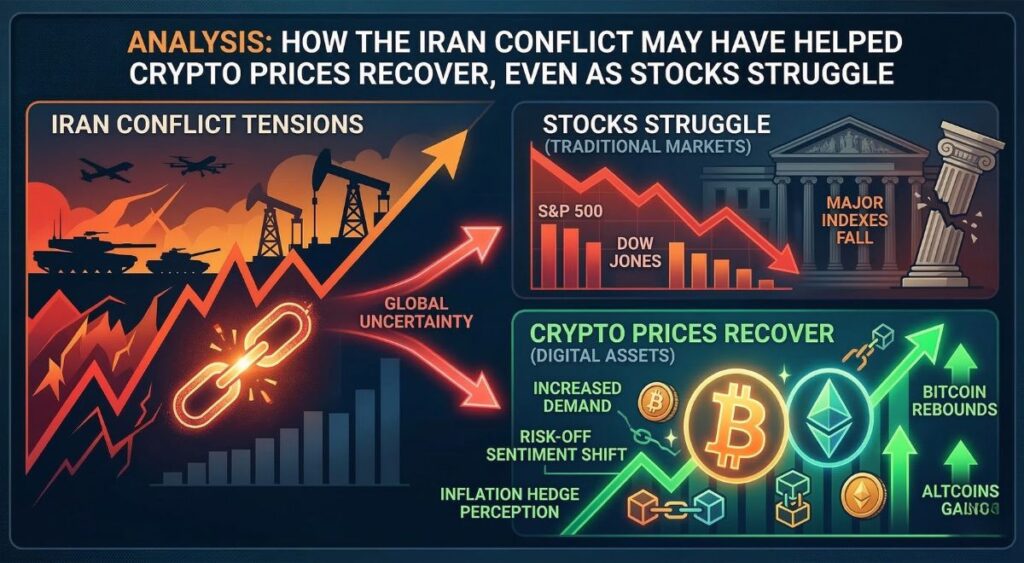
Global financial markets have been shaken by the escalating geopolitical tensions involving Iran, the United States, and Israel. While traditional financial markets have shown weakness amid rising uncertainty, cryptocurrencies—especially Bitcoin and Ethereum—have demonstrated surprising resilience. In some cases, digital assets have even recovered faster than stocks, highlighting how geopolitical conflicts can shift investor behavior across asset classes.
Market Shock: War Pressure Hits Global Stocks
Historically, geopolitical conflicts trigger a “risk-off” environment in financial markets. Investors typically reduce exposure to equities and move capital toward safer assets. This pattern appeared again as tensions escalated in the Middle East.
Major global stock markets experienced declines, including the S&P 500 and Nasdaq 100, which dropped as investors reacted to rising oil prices, inflation concerns, and uncertainty about the conflict’s duration.
The conflict also triggered sharp increases in energy prices, with oil surging above $100 per barrel amid fears of supply disruptions around the Strait of Hormuz, a critical global energy shipping route. Higher energy costs raise inflation risks and can slow economic growth—factors that typically pressure equities worldwide.
Crypto’s Early Drop — Followed by a Recovery
At the start of the crisis, cryptocurrencies were not immune to volatility. Bitcoin initially fell sharply as markets reacted to news of military strikes and retaliatory actions. However, unlike stocks, crypto prices rebounded relatively quickly in the following days.
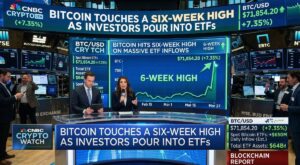
Within a short period, Bitcoin recovered toward the $68,000–$71,000 range, while Ethereum and other major cryptocurrencies also posted gains. This rebound occurred even as global stock markets remained under pressure.
This divergence has prompted analysts to examine why crypto markets appear to be recovering faster than traditional assets.
1. Crypto’s Borderless and Portable Nature
One reason is the decentralized and borderless nature of digital assets. During geopolitical crises, investors may worry about capital controls, sanctions, or disruptions in banking systems. Cryptocurrencies offer a way to move funds across borders without relying on traditional financial infrastructure.
As tensions increase, demand for portable assets can rise, particularly in regions close to conflict zones or countries facing financial restrictions.
2. 24/7 Trading Advantage
Unlike traditional stock markets that close on weekends and holidays, cryptocurrency markets operate 24 hours a day.
This continuous trading structure allows investors to respond immediately to breaking geopolitical developments. When the Iran conflict escalated over a weekend, crypto markets were effectively the only major financial markets open for trading, giving digital assets a structural advantage.
3. Oversold Conditions Before the Conflict
Another key factor behind the rebound is that cryptocurrencies had already experienced a significant correction earlier in the year. Both Bitcoin and Ethereum had dropped sharply before the conflict began.
Because of these earlier declines, many analysts believe digital assets were already “oversold.” The geopolitical shock created volatility but also triggered buying opportunities for investors looking to accumulate crypto at lower prices.
4. Growing Institutional Demand
Institutional investment is also playing a role in stabilizing the crypto market. Exchange-traded funds and large-scale institutional purchases have provided steady demand for Bitcoin even during periods of market turbulence.
Recent inflows into Bitcoin investment products suggest that institutional investors continue to view digital assets as a long-term investment despite short-term geopolitical risks.
5. Weak Correlation with Stocks
Although cryptocurrencies sometimes move alongside technology stocks, they are not fully correlated with traditional markets. Research suggests that only a portion of Bitcoin’s price movements are tied to stock market trends, with the majority driven by crypto-specific factors such as network activity, investor sentiment, and institutional flows.
This partial independence can allow cryptocurrencies to recover even when equities remain under pressure.
What Happens Next?
Despite the recent recovery, volatility remains high across both crypto and traditional markets. If the Iran conflict escalates further—especially if it disrupts global oil supply or triggers broader economic instability—both stocks and cryptocurrencies could experience additional turbulence.
However, if geopolitical tensions stabilize, cryptocurrencies may continue their recovery. Some analysts believe Bitcoin could attempt to test the $72,000–$73,000 range if positive momentum continues.