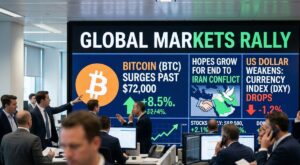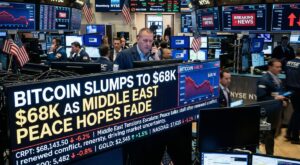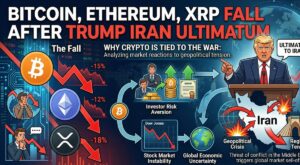

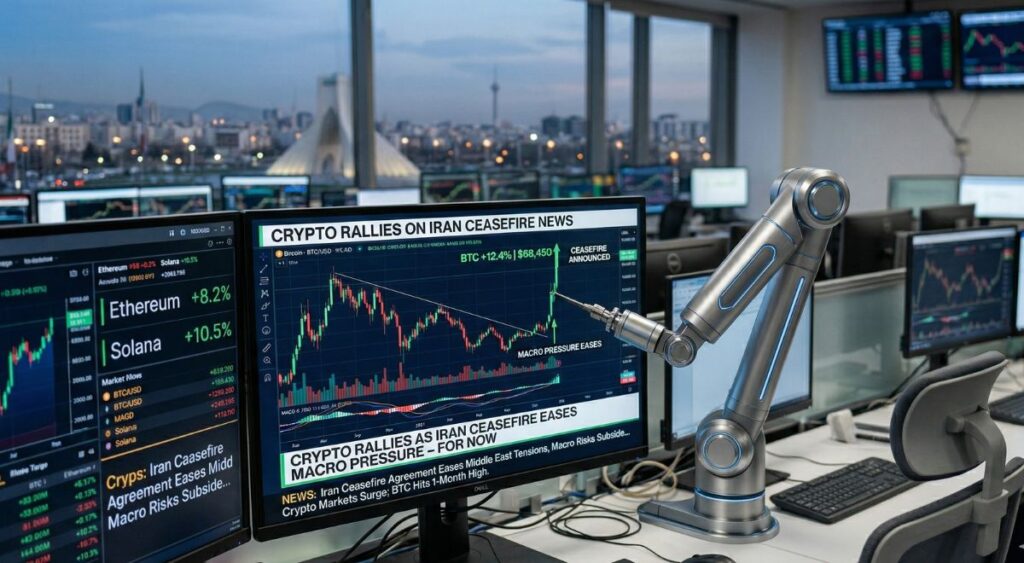
Global cryptocurrency markets surged sharply this week as geopolitical tensions between the United States and Iran temporarily eased, triggering a broad “risk-on” sentiment across financial markets. The rally highlights how deeply digital assets are now tied to macroeconomic developments, rather than operating as isolated alternatives to traditional finance.
Ceasefire Sparks Market Relief
The announcement of a two-week ceasefire between the U.S. and Iran marked a turning point after weeks of escalating tensions that had rattled global markets. The agreement, which includes the reopening of the critical Strait of Hormuz, immediately reduced fears of supply disruptions and runaway energy prices.
As a result, oil prices fell sharply—dropping more than 10%—while global equities surged in tandem.
This macro shift spilled directly into the crypto market, where investors rapidly rotated back into risk assets.
Bitcoin Leads the Rally
Bitcoin surged past $72,000, rebounding strongly from earlier lows near $68,000 as the ceasefire news broke.
The broader crypto market followed, rising nearly 4% and pushing total market capitalization above $2.4 trillion.
Major altcoins—including Ethereum, Solana, and XRP—also posted strong gains, reflecting a synchronized move driven not by project-specific developments but by improving global sentiment.
Notably, this rally reinforces a growing narrative: Bitcoin is behaving more like a macro-sensitive asset than a traditional safe haven. When geopolitical risks rise, crypto falls alongside equities; when tensions ease, it rallies.
Short Squeeze Amplifies Gains
The upward momentum was further accelerated by a wave of liquidations in the derivatives market. Roughly $270 million in short positions were wiped out as prices surged, creating a classic short squeeze that pushed crypto prices even higher.
This dynamic suggests that the rally was not purely driven by organic buying but also by forced market positioning adjustments.
Institutional Flows Send Mixed Signals
Despite the strong price action, institutional behavior paints a more cautious picture.
Data shows that while investors poured money into Bitcoin ETFs ahead of the rally, they began selling into strength once prices surged. On the day of the ceasefire announcement, ETFs recorded net outflows of over $150 million.
This pattern indicates that large players may be taking profits rather than positioning for a sustained breakout—raising questions about the durability of the rally.
A Temporary Boost, Not a Structural Shift
While markets have welcomed the ceasefire, analysts warn that the underlying conflict remains unresolved. The agreement is temporary, and tensions could quickly resurface if negotiations break down.
Historically, such geopolitical pauses tend to produce short-term relief rallies rather than long-term trend reversals. The crypto market’s recent price action appears consistent with this pattern.
What Comes Next?
The next two weeks will be critical for determining whether this rally has staying power. If the ceasefire holds and broader macro conditions stabilize, crypto could attempt a breakout above its recent range.
However, if tensions re-escalate, the same macro forces that fueled the rally could reverse it just as quickly.
For now, the crypto market is benefiting from a rare moment of geopolitical calm—but as history suggests, that calm may prove fleeting.