

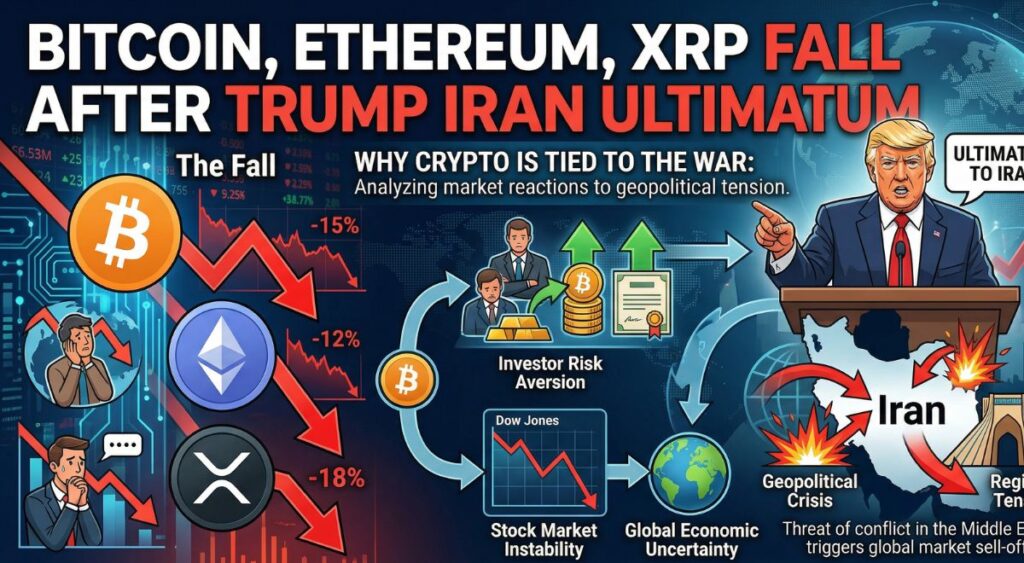
The cryptocurrency market faced renewed pressure as Bitcoin, Ethereum, and XRP declined sharply following escalating geopolitical tensions between the United States and Iran. The drop came after former U.S. President Donald Trump issued a high-stakes ultimatum to Iran, intensifying fears of a broader Middle East conflict and triggering a global market reaction.
Crypto Prices Slide Amid Rising Tensions
Major cryptocurrencies moved lower as uncertainty spread across global financial markets. Bitcoin fell around 1.6% to near $67,800, while Ethereum and XRP dropped by roughly 3% and 2.8%, respectively.
The sell-off wasn’t isolated to crypto. Stock futures also declined, while oil prices surged—clear signs that investors were reacting to heightened geopolitical risk.
The trigger? A 48-hour ultimatum from Trump, warning Iran to reopen the Strait of Hormuz or face attacks on its energy infrastructure. Iran responded with counter-threats, raising the risk of a prolonged conflict.
Why Crypto Is Reacting to the War
While cryptocurrencies are often described as “digital gold” or safe-haven assets, recent market behavior tells a different story. In times of geopolitical crisis, crypto is increasingly behaving like a risk asset rather than a protective hedge.
1. Flight to Safety
When war risks rise, investors typically move funds into safer assets like:
- Gold
- U.S. dollar
- Government bonds
Crypto, being volatile, often sees capital outflows, leading to price drops. Historical data shows that major conflicts or military threats trigger rapid sell-offs across digital assets.
2. Liquidity Shock and Panic Selling
Crypto markets are highly sensitive to sudden news. As tensions escalate:
- Traders exit leveraged positions
- Exchanges trigger liquidations
- Prices fall quickly
For example, previous Iran-related escalations wiped out hundreds of millions in leveraged crypto positions within hours, amplifying volatility.
3. Oil Prices and Inflation Fears
The Strait of Hormuz is a critical oil route, and any disruption pushes energy prices higher.
Higher oil prices lead to:
- Inflation concerns
- Central bank tightening
- Reduced appetite for speculative assets like crypto
This macroeconomic chain reaction directly impacts Bitcoin and altcoins.
4. Crypto’s Link to Global Finance and Sanctions
The Iran conflict also intersects with crypto in another way—sanctions and financial bypassing.
- Iran has increasingly used cryptocurrency to bypass global financial restrictions.
- Governments are closely monitoring crypto flows tied to sanctioned entities.
This adds regulatory pressure and uncertainty, which further weighs on market sentiment.
Not Always a Safe Haven
The idea of Bitcoin as “digital gold” is being tested. Analysts note that during extreme geopolitical stress, crypto tends to:
- Drop initially with risk markets
- Recover later once uncertainty stabilizes
In fact, some studies suggest Bitcoin behaves more like a tech stock than a traditional safe-haven asset during crises.
Could Crypto Recover?
Despite the short-term decline, the long-term outlook remains uncertain and depends on how the conflict unfolds:
- Escalation scenario: Continued war could push crypto lower due to sustained risk-off sentiment
- De-escalation scenario: Markets may rebound quickly, with crypto recovering alongside global equities
Past patterns show that Bitcoin often rebounds after initial panic selling, especially once geopolitical clarity emerges.
Final Thoughts
The recent drop in Bitcoin, Ethereum, and XRP highlights a critical shift: crypto is no longer isolated from global events. Instead, it is deeply intertwined with:
- Geopolitics
- Energy markets
- Investor sentiment
As the Iran crisis unfolds, cryptocurrency markets will likely remain volatile, acting as a real-time barometer of global fear and uncertainty.