
Iran’s deepening currency crisis is once again pushing citizens to search for alternative stores of value and payment mechanisms, reviving debate around whether Bitcoin can function as a financial lifeline when access to the internet and formal banking systems is restricted.
A Currency Under Pressure
The Iranian rial has faced repeated bouts of sharp depreciation, driven by a mix of international sanctions, structural economic weaknesses, capital flight, and declining public confidence. According to publicly documented timelines, the situation worsened after late 2024 when Iran’s central bank blocked bank accounts and payment terminals linked to online crypto-to-fiat exchanges, further tightening control over financial flows .
As inflation erodes purchasing power, ordinary Iranians increasingly think in dollars while earning in rials—a dynamic reflected in widespread protests over livelihoods and cost of living. In such an environment, Bitcoin has emerged less as a speculative asset and more as a hedge against monetary instability.
Bitcoin in Iran: Opportunity Meets Restriction
Iran’s relationship with cryptocurrency has always been ambivalent. While digital assets initially gained traction as a way to bypass sanctions and access global value networks, authorities have repeatedly imposed restrictions. By late 2024 and 2025, regulations tightened further, with bans on using cryptocurrencies and gold as substitutes for rial-based payments and increased state oversight of exchanges .
These measures have not eliminated interest in Bitcoin; instead, they have shifted usage patterns. Peer-to-peer transactions, informal custody methods, and cross-border arrangements have become more common, particularly among tech-savvy users and small merchants.
The Internet Problem
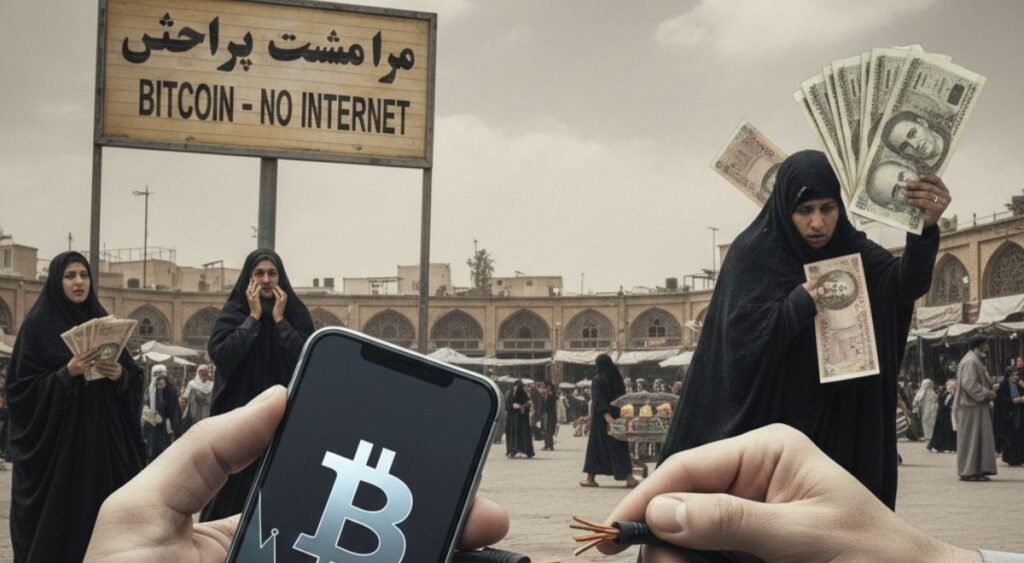
Bitcoin’s standard operation depends on internet connectivity—for broadcasting transactions, syncing wallets, and verifying balances. During periods of unrest or heightened state control, internet access in Iran has been disrupted or throttled, exposing a critical weakness in digital finance.
This challenge has sparked renewed attention on offline or low-connectivity solutions. Globally, developers have experimented with Bitcoin transactions via SMS relays, radio waves, mesh networks, and satellite broadcasts. In Iran, the relevance is heightened by the country’s long history of censorship-resistant communication technologies.
Lessons From Satellite Data Transfers
Iran already has experience with internet-independent digital distribution. Technologies such as satellite filecasting have been used to deliver data without relying on domestic internet infrastructure, demonstrating that information—and potentially transaction data—can move even under heavy restrictions .
While these systems are not purpose-built for Bitcoin, they illustrate a broader point: alternative transmission layers can exist. In theory, Bitcoin transaction data could be broadcast outward via satellite or radio, then confirmed on the global network, allowing users to participate with minimal connectivity.
Practical Limits of Offline Bitcoin
Despite its promise, truly offline Bitcoin remains difficult to scale. Users still need some form of connectivity—direct or indirect—to settle transactions on the blockchain. Latency, security risks, limited liquidity, and regulatory crackdowns all constrain adoption. For everyday commerce, volatility and usability remain major hurdles.
As a result, Bitcoin in Iran today functions more as a store of value and cross-border transfer tool than as a fully offline payment system. It complements, rather than replaces, cash, gold, and informal credit networks.
A Stress Test for Decentralized Finance
Iran’s currency crisis is effectively stress-testing Bitcoin’s original promise: money without banks, borders, or permission. The experience shows both the resilience of decentralized assets under pressure and their current limitations when infrastructure and regulation are hostile.
While Bitcoin cannot yet operate seamlessly without the internet, Iran’s case underscores why demand for such capabilities exists. As economic instability and digital controls intensify, the push to make decentralized finance more resilient—technically and socially—will likely continue, in Iran and beyond.