
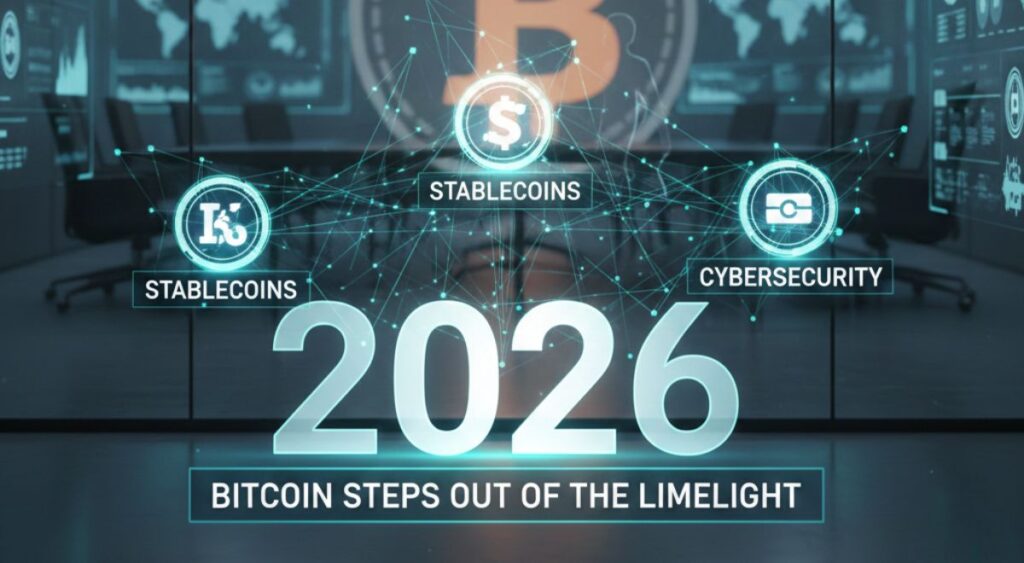
As 2026 approaches, expectations across the crypto industry have noticeably cooled compared to the optimism seen a year earlier. After a volatile final quarter of 2025, analysts and market leaders are taking a more measured view of what lies ahead. While some still believe Bitcoin could eventually move beyond its October peak of $126,000, the broader conversation has shifted away from token prices and toward infrastructure, protocols, and real-world blockchain integration.
Rather than chasing speculative highs, the industry is increasingly focused on long-term development. Stablecoins, decentralized protocols, cybersecurity, and practical blockchain use cases are expected to define the next phase of growth as digital assets continue to merge with traditional financial systems.
Major Crypto Narratives Shaping 2026
One of the most significant developments expected in 2026 is the deeper integration of artificial intelligence across the crypto ecosystem. However, attention is turning away from centralized AI models toward decentralized alternatives.
Industry leaders argue that decentralized AI could address one of the sector’s biggest challenges: energy consumption. As centralized AI models reach their scaling limits, decentralized networks are emerging as a more efficient and scalable solution. This shift is expected to position AI as one of Web3’s most important use cases, driving demand for sovereign, verifiable, and energy-efficient systems.
At the same time, rising geopolitical uncertainty is increasing demand for privacy and anonymity. Blockchain technology is expected to play a key role in verifying authenticity, combating misinformation, and enabling “user-generated AI” systems where provenance and trust are essential. Alongside this, physical AI—robotics and embodied intelligence—is projected to move into the mainstream, with 2026 potentially marking a breakthrough year for real-world autonomous systems.
Another growing theme is the demand for auditable and verifiable intelligence. Rather than massive, general-purpose models, markets are beginning to favor specialized AI systems that can prove data integrity, privacy, and origin—capabilities that align naturally with blockchain-based solutions.
A Hybrid Crypto Market Takes Shape
Crypto markets in 2026 are expected to become increasingly hybrid. On one side, AI-driven trading systems will dominate high-speed analysis, execution, and signal generation. On the other, tokenized real-world assets are gaining traction among investors seeking on-chain exposure with reduced volatility.
Assets such as government bonds, commodities, and structured credit are being tokenized to provide stability while remaining native to blockchain infrastructure. This dual approach is helping crypto evolve beyond speculation into a more balanced financial ecosystem.
Meanwhile, Web3 wallets are rapidly transforming into intelligent financial platforms. Beyond asset storage, these wallets are expected to automate budgeting, portfolio rebalancing, subscription tracking, tax reporting, and compliance. Together with the rise of 24/7 tokenized trading for stocks and ETFs, this could lead to a continuously operating global financial market with improved accessibility and risk management.
On the regulatory front, attention is shifting decisively toward stablecoins. Governments and institutions are increasingly focused on their regulation, adoption, and role in cross-border payments, rather than on Bitcoin itself.
Bitcoin Enters a Consolidation Phase
Despite Bitcoin’s strong performance in 2025, sentiment has cooled heading into 2026. Many analysts believe Bitcoin is entering a consolidation phase rather than gearing up for an immediate breakout.
Historical patterns suggest that Bitcoin often peaks around U.S. election cycles, and recent price action supports the idea of a sideways market rather than a sharp rally or collapse. Liquidity conditions remain mixed, with some monetary easing expected globally but tighter conditions in the United States.
Market data reflects this uncertainty, with wide-ranging price expectations indicating equal probabilities of significant upside or downside moves. As a result, many experts are avoiding short-term price predictions altogether.
Bitcoin is increasingly behaving like a mature macro asset rather than a high-growth speculative investment. While this may result in a quieter year, long-term confidence remains strong. Growing institutional access, evolving monetary policy, and demand for alternatives to traditional currencies continue to support Bitcoin’s broader investment thesis.
Institutional Demand Brings Greater Stability
One of the most notable changes in recent years is the growing role of institutional investors. Large-scale transactions now dominate Bitcoin trading activity, reducing the influence of retail speculation.
This shift is expected to smooth out market cycles, resulting in shallower pullbacks, lower volatility, and faster recoveries. Exchange-traded products, long-term holders, and institutional allocators are helping to create a more resilient market structure, potentially setting the stage for renewed growth beyond 2026.
From Altcoins to Protocols: A Strategic Reset
While early 2025 was driven by token hype, experts believe 2026 will be defined by a return to fundamentals. Many Layer 1 blockchains continue to struggle with weak demand and ineffective value capture, even as adoption grows.
Instead, attention is moving up the stack. Layer 2 networks and application-layer protocols are expected to outperform because they are closer to real economic activity and can generate recurring revenue. Projects tied to stablecoin usage, on-chain derivatives, tokenized credit, and real-world asset infrastructure are particularly well positioned.
This renewed emphasis on revenue and utility marks a departure from narrative-driven investing. As capital becomes more selective, projects with sustainable economics and real users are likely to stand out—potentially favoring crypto-related equities over speculative tokens.
Bitcoin, meanwhile, continues to occupy a distinct position. Unlike other crypto assets, it does not directly compete with AI-driven growth narratives for investor attention, allowing it to maintain its role as a long-term macro hedge.
Simplicity, Transparency, and Privacy Define the Next Era
Across the industry, 2026 is expected to reflect a more mature crypto environment. Technology, rather than token speculation, is becoming the central focus. Users are more sophisticated, regulators more engaged, and expectations higher.
Projects that prioritize simplicity, transparency, security, and privacy are likely to gain trust and traction. As blockchain adoption accelerates quietly behind the scenes, the industry’s next phase will be less about hype and more about building systems that work at scale.